The first fundamental basis
An answer, not a copy.
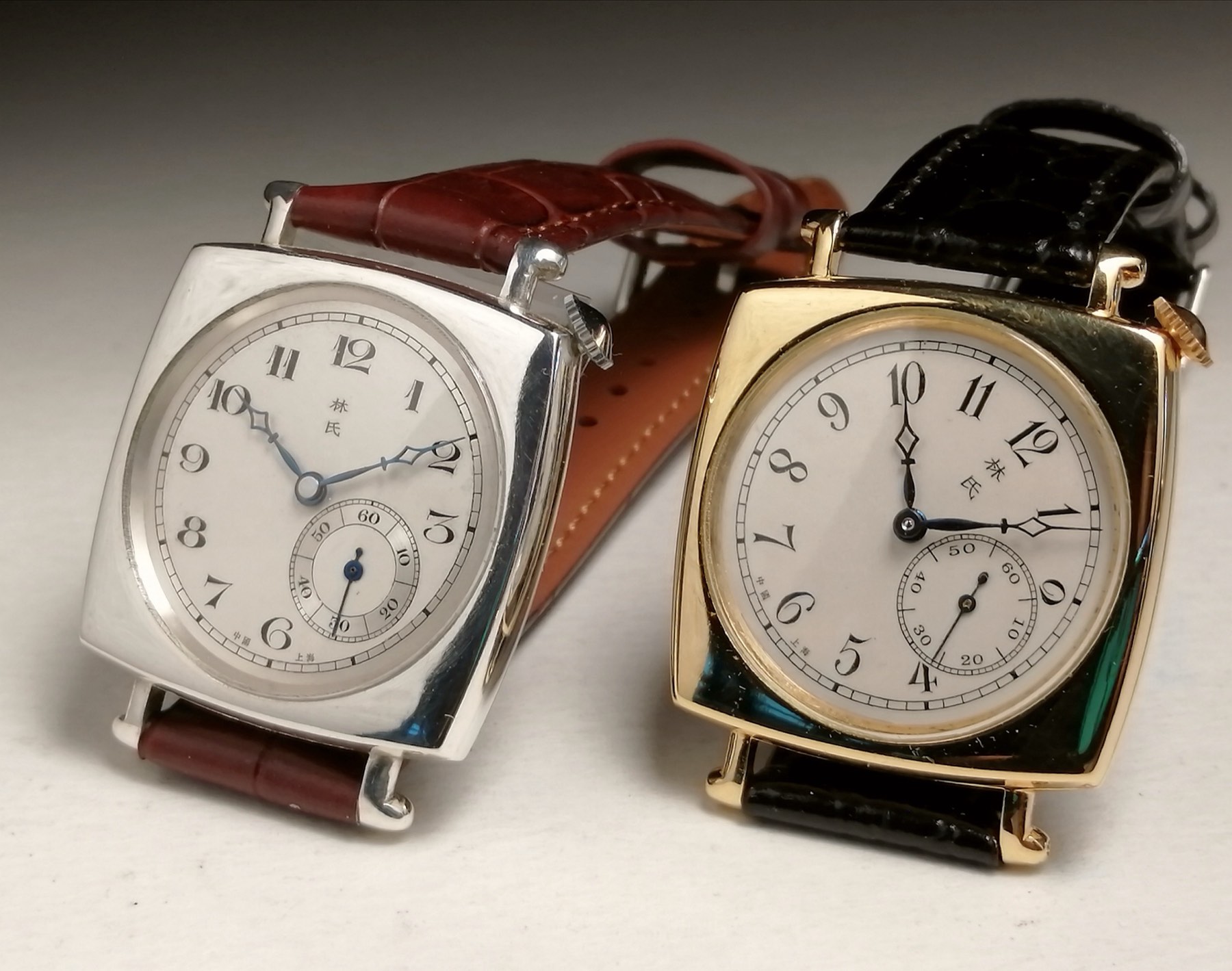
It began with a photograph of the Vacheron Constantin American 1921, pinned not to a wall but to the back of my mind. The watch in the image was an odd and elegant thing: a cushion-form case with its dial turned roughly forty-five degrees, crown displaced toward one o’clock, as if the entire object had been composed for a wrist already angled at the wheel of a car. I did not want to imitate it. I wanted to answer it. That answer required a collaborator, and so I brought the idea to watchmaker Guo Hao (郭昊, 1900).
Mr. Guo understood immediately that the project was not about reproducing a historical shape but about renegotiating its proportions for a modern wrist. We settled on a cushion case of approximately thirty-three millimeters. The figure sat deliberately between the roughly 31.5 millimeters of the original and the forty millimeters of many contemporary reissues. We wanted presence without bombast, intimacy without fragility.
But a cushion case is a treacherous form. Done badly, it becomes a square brick—rigid, unyielding, all hard corners. Done worse, it becomes a fat little ingot, too thick for its width, swinging heavily on the wrist. Mr. Guo insisted the watch should feel cushion-like, with soft shoulders and rounded geometry, but never overweight. That single demand pushed us toward the movement.
There are, of course, many movements available. Some descend from pocket-watch calibres; we examined them. Others already power modern wristwatches; we considered them as well. But every path ran into the same three walls: thickness, parts availability, and ease of service. Eventually we chose the ETA 7001. It was not a poetic choice, but it was the right one. The ETA 7001—originally the Peseux 7001—is a hand-wound calibre measuring 10.5 lignes, or 23.3 millimeters in diameter, and only 2.5 millimeters thick. It carries seventeen jewels, beats at 21,600 vibrations per hour, and stores roughly forty-two hours of power. More importantly, it is a movement the world knows how to service. It is mass-produced, so replacement parts are ordinary rather than archaeological. It is thin, so the case could remain low and quiet on the wrist. That became the first fundamental basis of the plan.
From there the making began in earnest. At first we assumed the outer case would be fabricated entirely by hand, but the design kept shifting in small, consequential ways. We turned to 3D printing. The process started with manual measurements and hand-drawn plans, which became three-dimensional models, which became printed shells we could physically wear. We installed the ETA 7001 into a series of printed prototypes and carried them through daily life, testing how the case sat on the wrist, how the crown at one o’clock pressed against the hand, how the whole object behaved in motion. The prototypes were merciless teachers. Too square. Too thick. Too heavy. Too sharp. Gradually the shape learned its own limits.
When the form finally settled, we made another decision. The case would not be machined or stamped. It would be cast—using the same casting method employed for fine jewelry, in which precious-metal components are formed and then finished by hand. We would pass the case to artisans who specialize in this kind of jewelry work. And we wanted to test the design in two materials. One version would be silver, carrying its own particular dial treatment. The other would be gold, bearing the tilted dial layout. The purpose was not merely aesthetic; it was investigative. We wanted to understand how the offset-crown case shape performed in different metals, and how each version looked and felt on the wrist.
The dial brought its own quiet struggle. We did not have access to reliable pad printing, so the numerals and lettering could not be applied in the usual industrial manner. Instead they were laser-engraved into the dial surface, then filled by hand, and then baked. The process is slower and less repeatable, but it gives the dial a depth that pad printing cannot reproduce. The hands were heat-blued, their color achieved through controlled oxidation rather than paint.
What emerged was less a copy than a continuation: a tilted dial inside a soft cushion case, rescaled for daily wear and powered by a movement that would never become a burden. Mr. Guo and I began with a photograph and ended with an object. The first fundamental basis is exactly that—a basis.