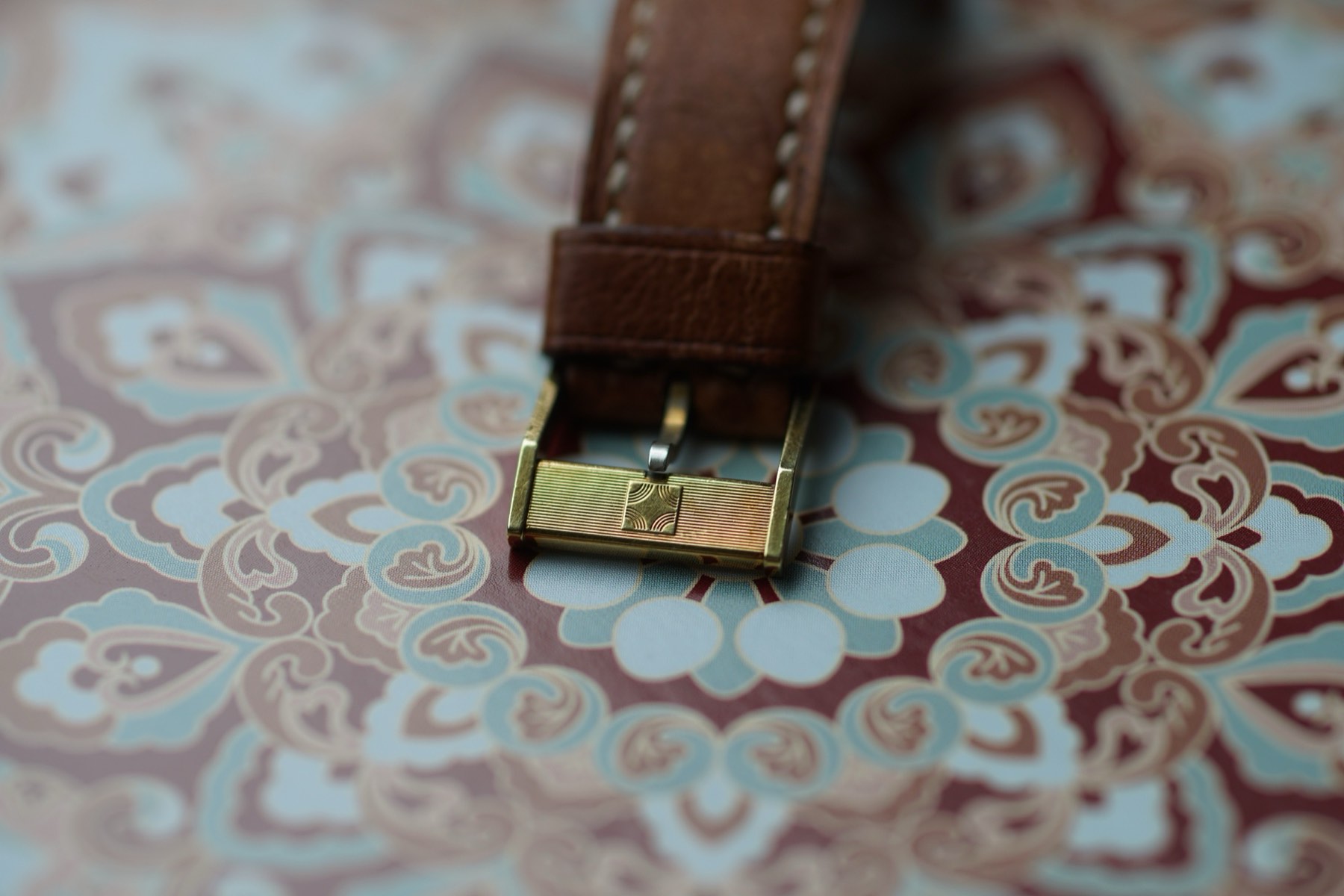
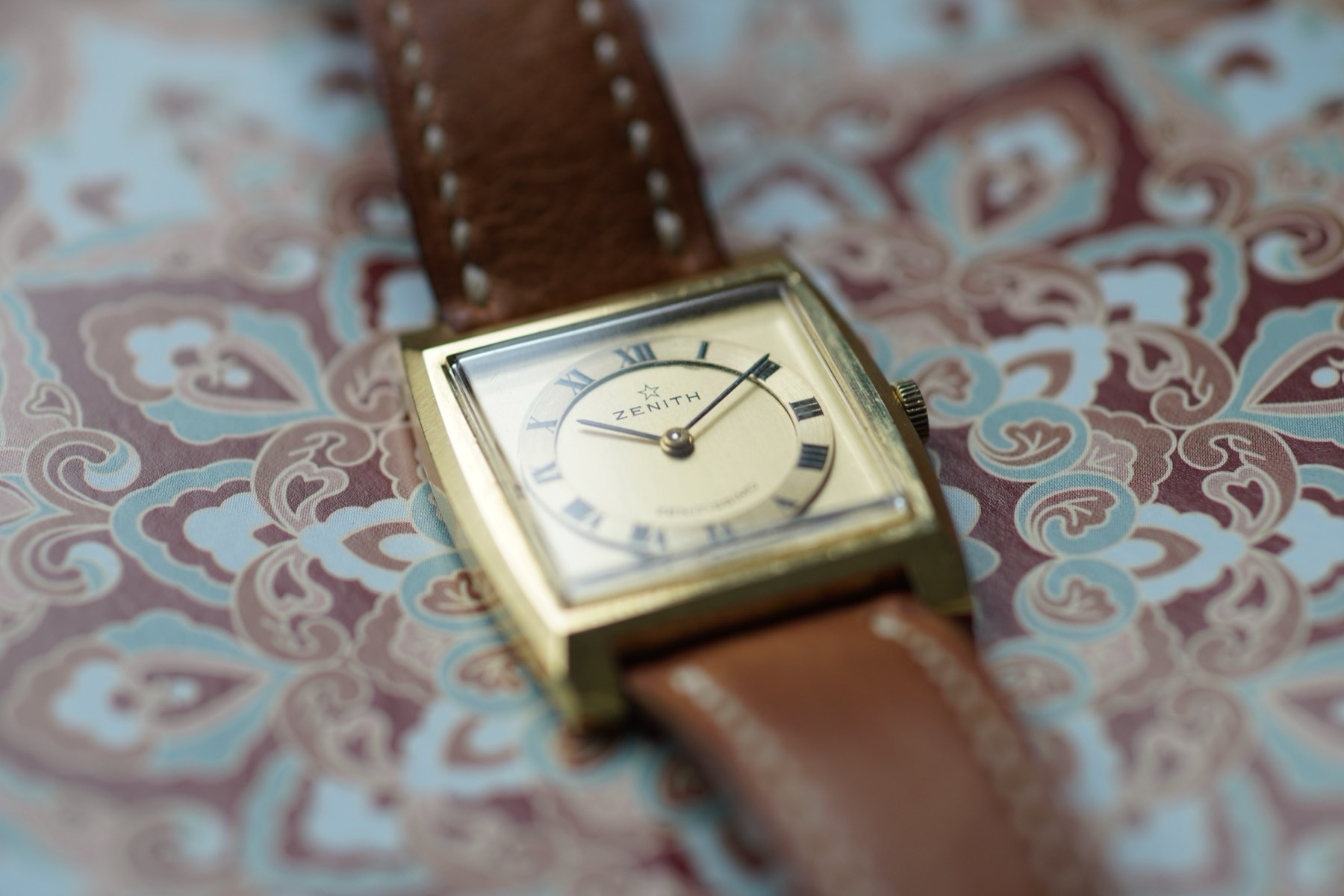
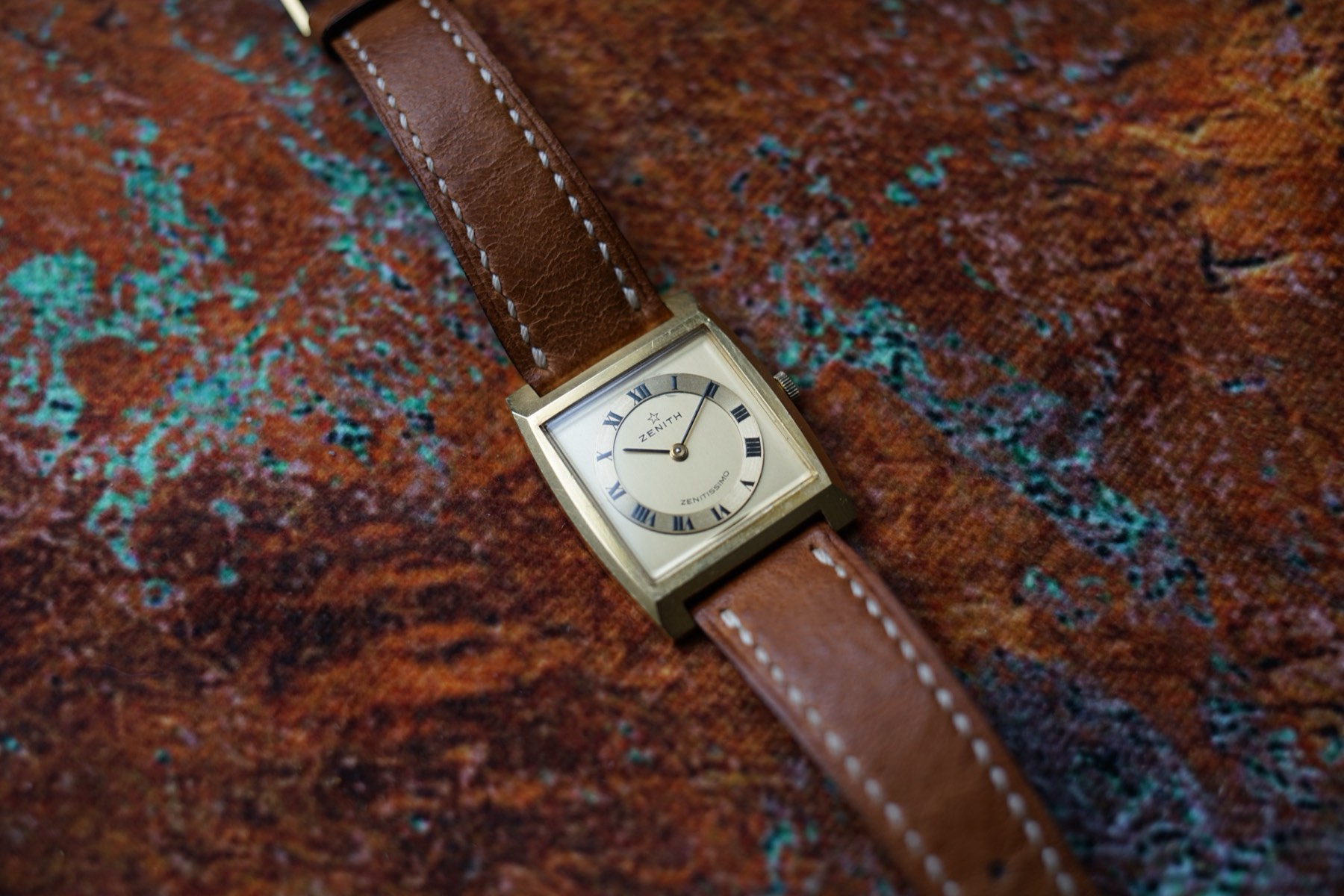
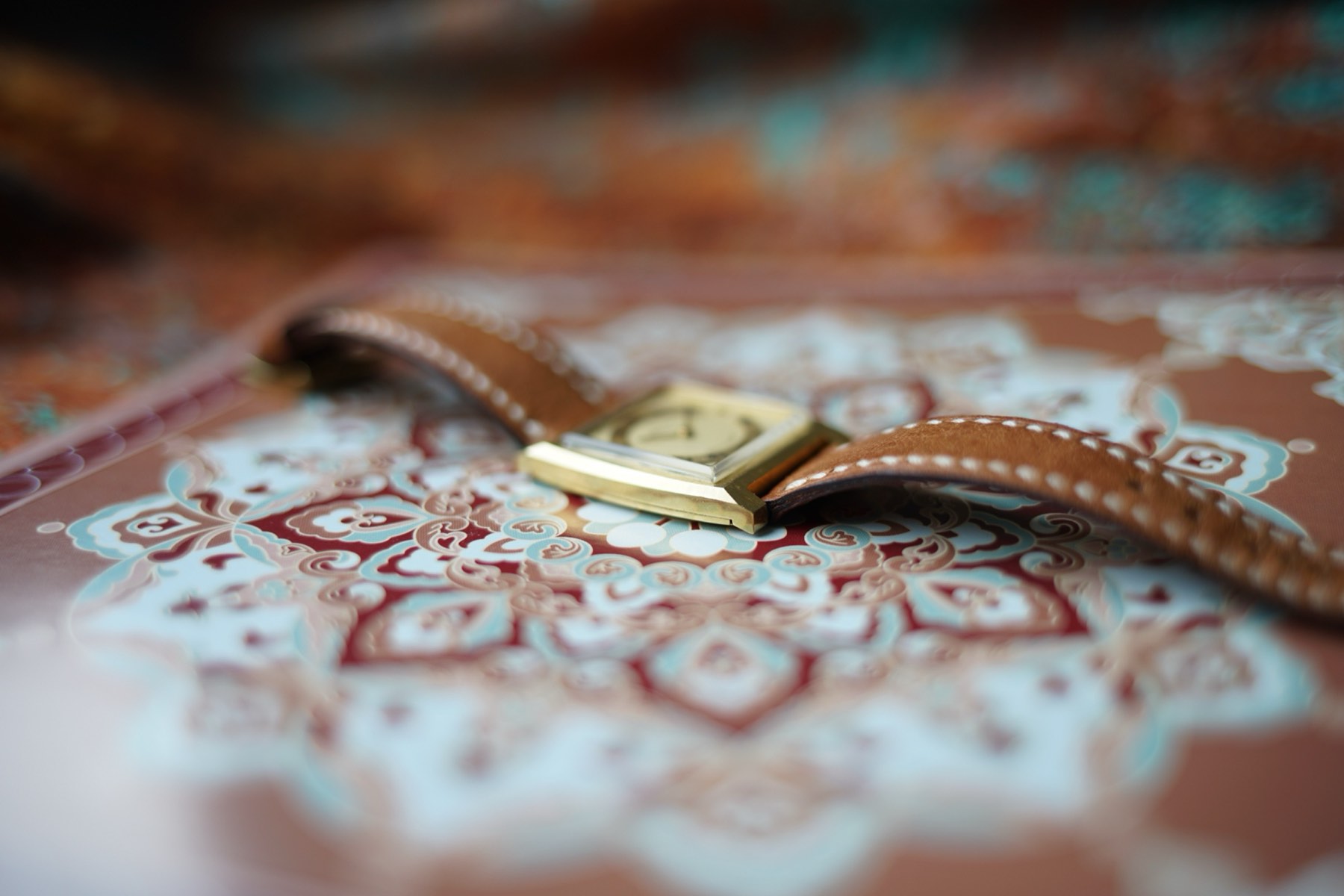
A Zenith Zenitissimo from around 1968 to 1970 — a slim square of 18K yellow gold that asks almost nothing of the wrist it rests on, and returns a whole day of quiet, reliable time.
Piece O / Collection photograph18K yellow gold, champagne dial
01 / What it is
Zenith named it the Zenitissimo, and the name is nearly a description: a dress watch made as small and as gentle as a watch can be. The case is a soft square, barely 28 millimetres across, carrying a high box of acrylic crystal over a champagne dial. A raised silver chapter ring holds painted black Roman numerals, and two black baton hands move without a seconds hand to interrupt them. There is no fuss, no running seconds, no date — only the hour and the minute, kept the way a good sentence keeps only the words it needs.
02 / On the wrist
This is the part the photographs cannot show. The Zenitissimo is small, but its real gift is how little it weighs and how flat it lies. The case settles close to the skin and the sides fall away without bulk, so it disappears onto a slender wrist and never crowds a larger one. Put it on with a suit and it reads as intention; put it on with an old shirt and it reads as ease. The same watch, the same quiet square, belongs to both — a rare thing, to be formal and forgiving at once.
03 / Where & when
Zenith built it in Le Locle, the Swiss mountain town where the manufacture has kept its time since 1865. The Zenitissimo belongs to the late 1960s, those few years around 1968 to 1970 when a dress watch was still allowed to be tiny and unapologetic. Inside sits the manual calibre 1730 — a hand-wound movement Zenith shaped for thinness and steadiness rather than spectacle, beating at 21,600 vibrations an hour.
A quiet safeguard
The step that watches your hand.
Look closely by the crown and you find a small raised step cut into the case. It is easy to miss, and that is the point. The step stops a hand from winding the crown too hard — a quiet guard against the moment of impatience when a turn might snap the stem. Zenith did not have to shape the metal there. They did it anyway, because a watch this considered also looks after the person wearing it.
01 / The crown guard step
02 / Bevelled edges
Calibre 1730 / case finishing
Small case. Long hours.
The case finishing is the other quiet argument. The edges are bevelled with a care you only feel when the light runs across them — each facet taken slowly, each angle considered, so the gold catches the room rather than the workshop. And behind the dial, the calibre 1730 does its patient work: hand-wound, but generous with the hours it returns, running through a long day on a single turn. A small movement, given room to labour.
Case / ~28 × 28 mm, ~33.5 mm lug-to-lugThickness / ~6.5 mm including crystalMaterial / 18K yellow goldMovement / Zenith calibre 1730, manualFrequency / 21,600 vibrations per hourDial / champagne, Roman numerals, two hands
Piece O / Photo album / 5 photographs
Turn the pages.
A hand-bound album of the Zenith Zenitissimo. Swipe left or right, use the ← → keys, or click a page to open it full screen.