Collection / Piece Kc. 1995–98 / Ref. 30.0240.400

Zenith / Chronomaster El Primero

The Zenith
That Survived Twice.

A mid-1990s gold Chronomaster, reference 30.0240.400/01: 40 mm of 18K yellow gold around a pressed silk dial and the El Primero calibre 400 still beating ten times a second.

Mid-1990s Zenith Chronomaster El Primero in solid 18K yellow gold, worn on the wrist
Piece K / Collection photographRef. 30.0240.400/01

Research / the record

The Zenith That Survived Twice

Inside a mid-1990s, solid-gold Chronomaster that paired one of watchmaking’s great industrial movements with one of Zenith’s most unexpectedly elaborate dials

There are El Primero watches that announce themselves from across the room. The original A386 does it with three differently colored registers. The A384 does it with its tonneau case and panda dial. The Rainbow Flyback does it with the visual language of aviation instruments.

This Zenith does something quieter.

Reference 30.0240.400/01—also recorded in period and auction documentation as 14/30.0240.400—is a 40mm chronograph made almost entirely from the visual vocabulary of a traditional dress watch. Its case is solid 18K yellow gold. Its numerals are applied rather than painted. The hands are slender and formally shaped. Across the dial, several tightly repeated geometric patterns catch and release the light like woven silk.

Then the chronograph starts, and the central hand begins stepping around the dial ten times per second.

That juxtaposition is the point of the watch. Beneath a surface suggesting old Geneva is one of the most technically ambitious serially produced chronograph movements of the 20th century.

This is not one of the watches normally placed at the center of the El Primero story. But it may be one of the best watches through which to understand what Zenith was attempting during the 1990s: not simply bringing back a famous movement, but rebuilding an entire identity around it.

01 / Chapter

A Chronomaster From The Beginning

Zenith officially dates the birth of the modern Chronomaster collection to 1994. It arrived alongside the new Elite movement and represented the manufacture’s return to a more traditional conception of Swiss luxury: mechanical movements, chronometer certification, classical cases and visible mechanics.

The company had already restarted El Primero production during the previous decade. Ebel had helped demonstrate that a market again existed for refined mechanical chronographs, while Rolex’s decision to use a substantially modified El Primero in the automatic Daytona gave Zenith’s architecture an extraordinary external endorsement.

But the early Chronomaster was different. Here, Zenith was no longer merely supplying a mechanism or reviving an old technical achievement. It was presenting the El Primero as the foundation of its own high-end watchmaking identity.

The gold reference seen here belongs to that first generation. Properly documented examples appear from 1995, with further examples dated to 1997 and 1998. An Antiquorum example made circa 1995 was accompanied by its original Zenith box, certificate and separate COSC chronometer certificate. Other full-set examples dated 1995 and 1998 establish the reference firmly within the original mid-1990s Chronomaster period.

That makes the watch a pre-LVMH Zenith. The luxury group would acquire the manufacture in 1999, shortly before Zenith entered a far more theatrical period of open dials, enormous cases and highly complicated El Primero derivatives. This earlier watch comes from a narrower window, when Zenith’s idea of modernity was still expressed through restraint, mechanical credibility and a surprisingly dense application of traditional decoration.

02 / Chapter

Gold, But Not Delicate

At approximately 40mm across and around 12mm thick, this was a substantial gold watch for the middle of the 1990s. Many contemporary dress watches remained between 34 and 38mm, while traditional manually wound chronographs were often similarly restrained.

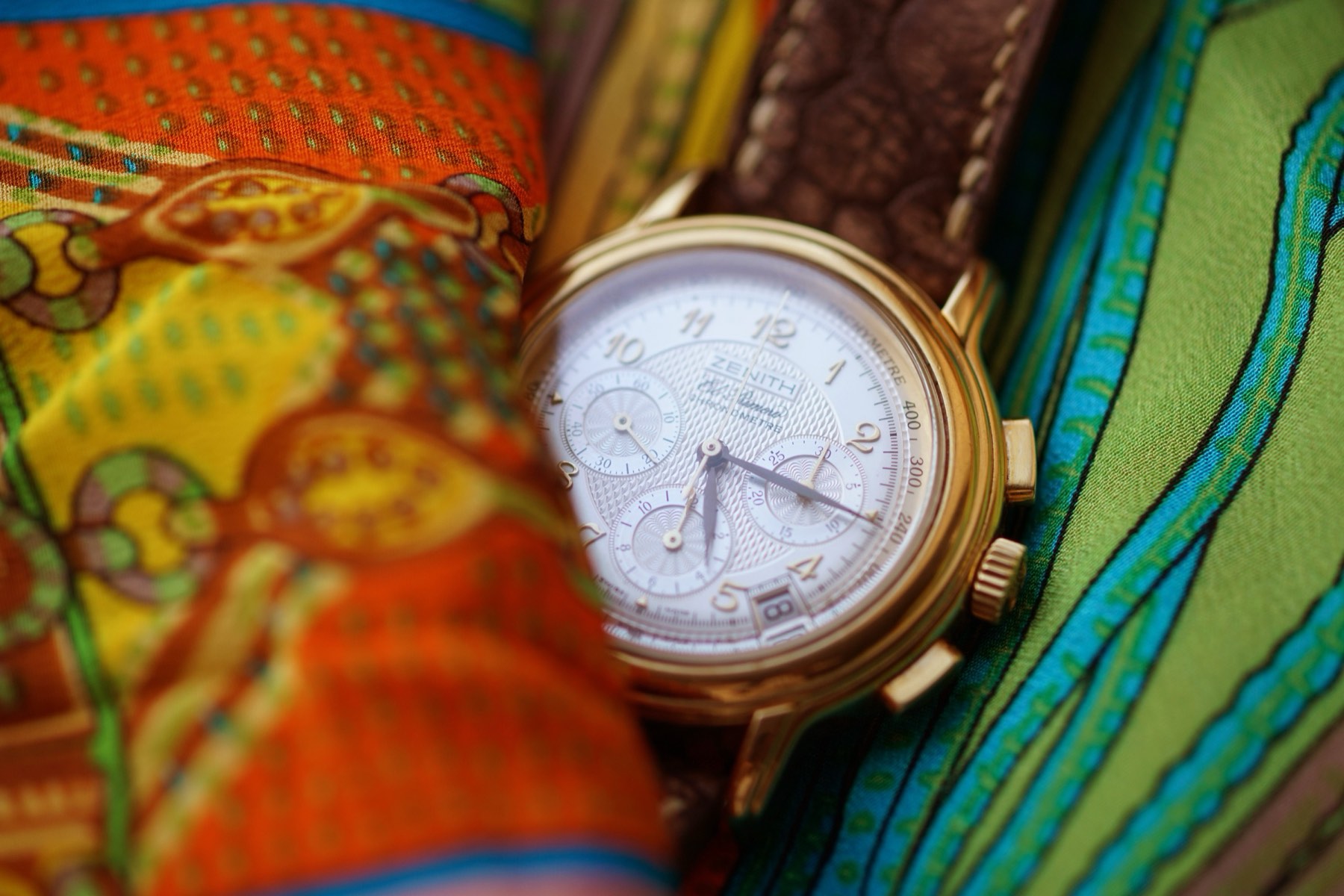
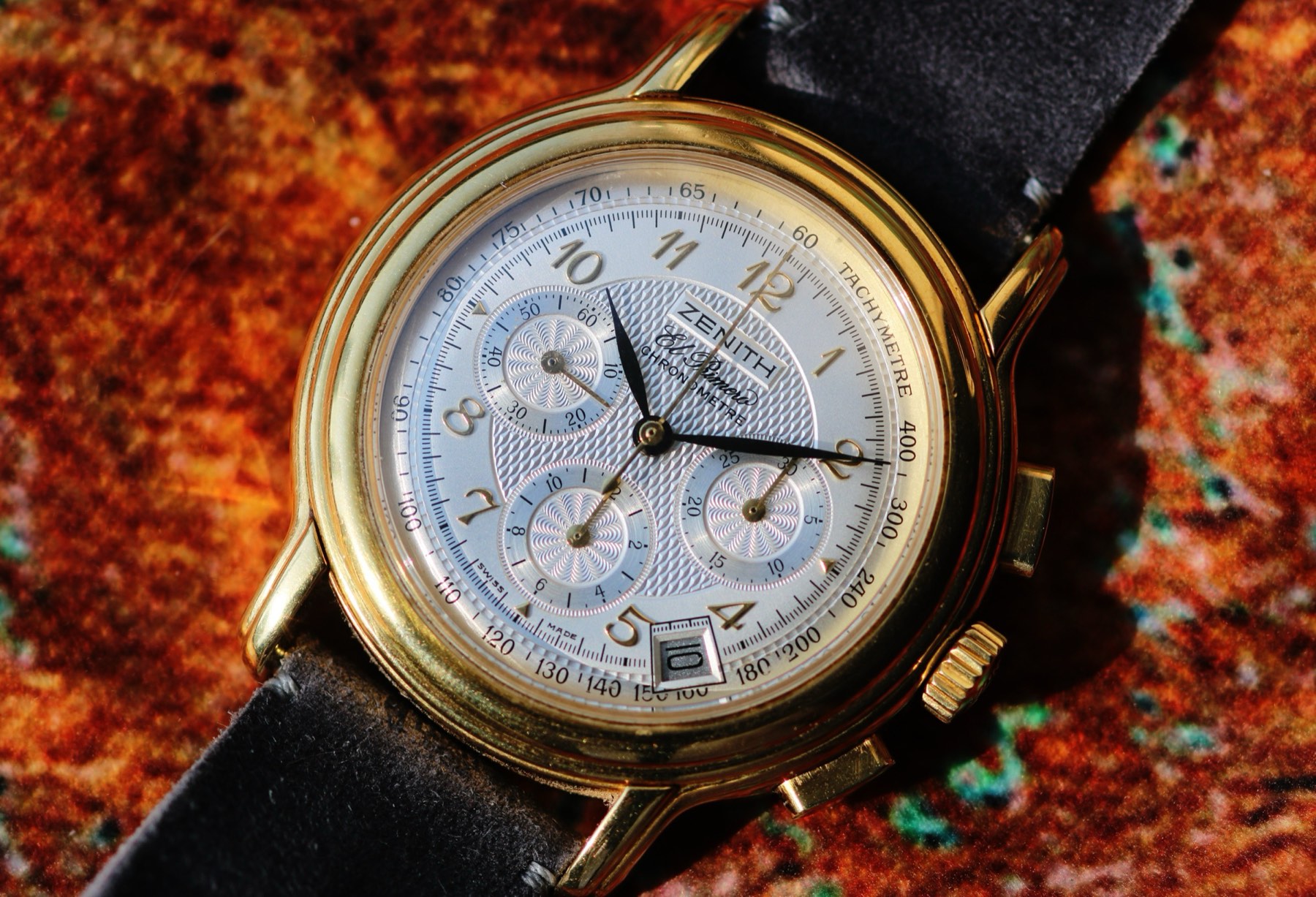
The Chronomaster’s size was partly dictated by the movement and dial architecture, but it also gave the watch physical authority. The stepped bezel rises around a domed sapphire crystal. The lugs are long, straight and slightly downturned. Rectangular chronograph pushers project from the case without the guards or sculpted shoulders that would later become common on sports chronographs.

The case is polished throughout, allowing the yellow gold to behave almost like a frame around the much more complicated dial. Around the back, six screws secure a sapphire display window. The surrounding gold ring is engraved with the Zenith name, Chronomaster designation, water-resistance language and Modèle Déposé—an indication of a registered design rather than the model’s name.

Originally, these watches were normally supplied on leather with a signed 18K Zenith pin buckle. The result was not really a sports watch, despite the tachymeter and chronograph. Nor was it a conventional dress watch. It was closer to a technical chronometer dressed for evening use.

03 / Chapter

A Dial That Rewards Magnification

The dial is where this version separates itself from the more familiar El Primero references.

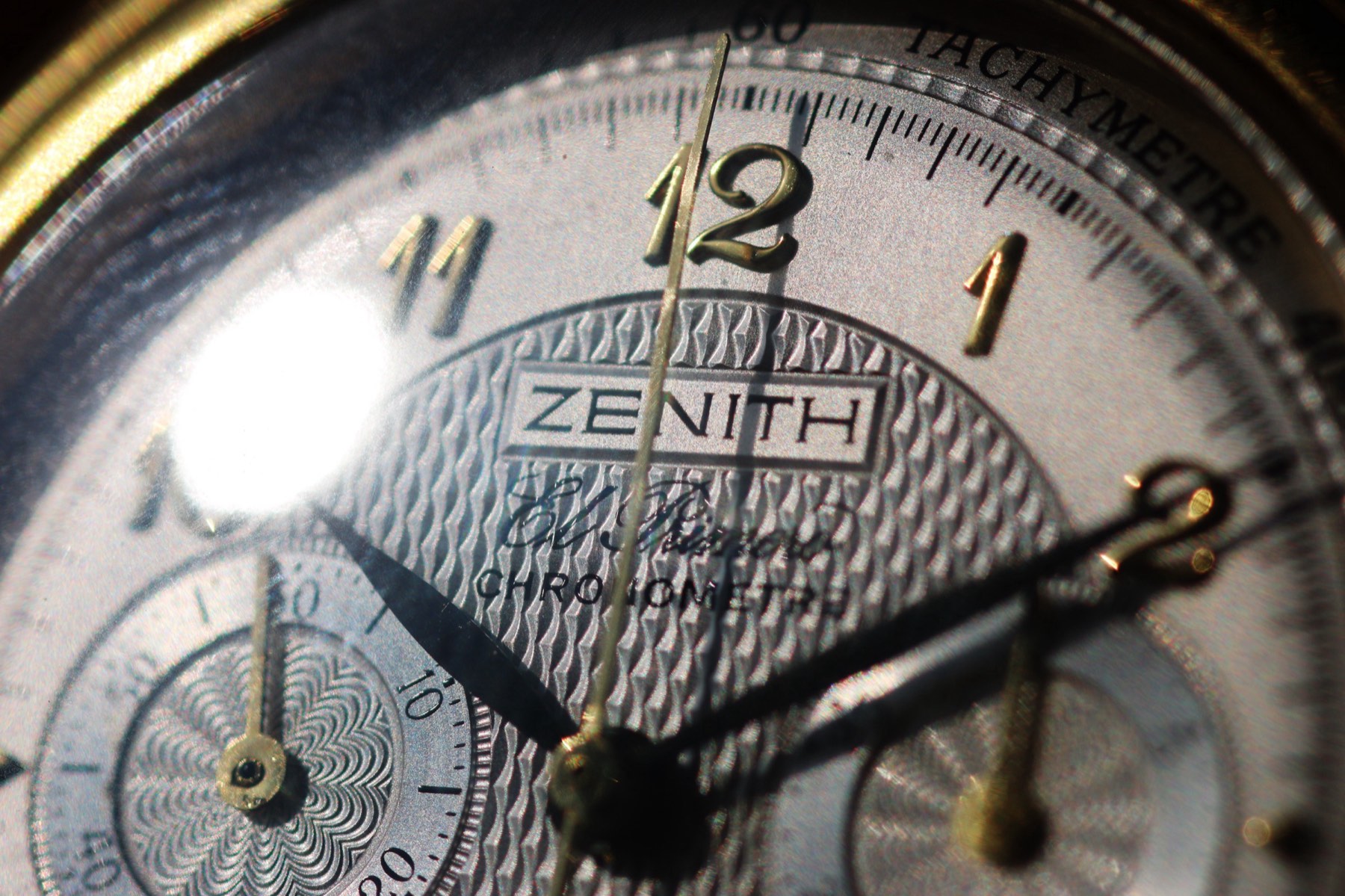
At first glance it appears conventionally silver, perhaps with a slight champagne warmth created by the gold case and applied furniture. Under directional light, however, the surface breaks into several distinct areas.

The center is filled with a repeated basket-like pattern, resembling a tightly woven textile or a variation on the traditional panier motif. Each recessed subdial contains its own radial rosette. Smooth silvered rings surround those rosettes, giving the printed scales a calm surface against which they can remain legible.

Applied yellow-gold Arabic numerals occupy the available hour positions, while small triangular markers stand in where the chronograph registers prevent full numerals from being used. At the perimeter is a printed minute and chronograph track, followed by an outer tachymeter scale extending to 400. The date remains in the traditional El Primero position between four and five o’clock.

It is an extraordinarily busy dial, but it is not accidental. Every texture establishes a visual boundary between one function and the next. The smooth outer ring, woven center and floral registers prevent the dial from becoming one undifferentiated silver surface.

Auction catalogues and dealers commonly describe the decoration as guilloché. In the broad commercial use of the word, that is understandable. The dial clearly employs traditional guilloché patterns and creates the characteristic movement of light associated with engine-turned metal.

The manufacturing method, however, was almost certainly different from traditional hand-operated rose-engine guilloché.

In genuine engine turning, a burin cuts each line into the metal while an artisan operates a rose engine or straight-line machine. The resulting surface contains actual cut grooves, including microscopic tool striations and small variations created by pressure and hand control.

On this Zenith, the remarkable regularity, softer relief and serial use of the same patterns across related steel and gold Chronomasters point instead to a pressed dial. A patterned die would have displaced the metal of the dial blank under substantial pressure, reproducing the basket and rosette motifs efficiently and with excellent consistency. The surface could then be silvered, printed and fitted with its applied numerals and markers.

That distinction should not be confused with the difference between a good dial and a bad one. This remains a complicated, multi-operation dial with several levels, recessed counters, applied gold furniture and extremely fine printing. Pressing explains how the relief was produced; it does not reduce the visual achievement.

Indeed, the dial’s ability to transform under light may be the watch’s most distinctive quality. At some angles it looks almost white and restrained. At others the center becomes a field of individual reflective facets, while the subdials resemble mechanical flowers.
04 / Chapter

The Machine Beneath It

Through the sapphire back is the El Primero calibre 400, descended directly from the 3019 PHC introduced in 1969.

The movement is approximately 30mm in diameter and only about 6.5mm thick—compact dimensions considering that it combines automatic winding, a date and a fully integrated chronograph. It uses 31 jewels, beats at 36,000 vibrations per hour and provides approximately 50 hours of power reserve.

Its chronograph is controlled by a column wheel and uses traditional horizontal coupling. When the start pusher is pressed, the column wheel coordinates the movement of the chronograph levers and allows the coupling wheel to engage with the chronograph train. The mechanism is mechanically expressive in a way that modern vertically coupled chronographs often are not: gears move laterally into engagement, levers visibly change position and the column wheel acts as the system’s rotary switch.

The automatic rotor winds in both directions and runs on a ball bearing. Around it are rhodium-plated bridges, blued screws and the compact, dense arrangement for which the El Primero is known. It is not decorated like a low-production Geneva movement, nor is it pretending to be one. Its beauty comes from architecture and activity.

At 5 Hz, the balance completes five full oscillations—or ten semi-oscillations—every second. This gives the chronograph hand its characteristic ten-step sweep and provides the mechanical basis for measuring tenths of a second.

The higher frequency also places greater demands on the escapement. More impulses mean more energy consumption and a greater dependence on correct lubrication. Servicing should therefore be entrusted to someone genuinely familiar with the El Primero rather than to a watchmaker who merely services ordinary automatic movements. Amplitude readings also need to be interpreted in the context of a 36,000-vph calibre.

The calibre 400 of this period does not hack when the crown is pulled. That is not a fault; it is part of the historical architecture. Stop-seconds would arrive in much later El Primero developments.

05 / Chapter

The Race Of 1969

The original El Primero project began during the early 1960s. Zenith initially hoped to produce an automatic chronograph in time for its centenary in 1965, but the undertaking proved considerably more difficult than expected.

Zenith was not attempting simply to attach an automatic winding system to an existing hand-wound chronograph. The company wanted the chronograph and automatic mechanism designed as one compact, integrated calibre. It also specified a centrally mounted rotor, column-wheel operation, a date, high-frequency regulation and more than 50 hours of power reserve.

Zenith publicly unveiled El Primero on January 10, 1969. The company calls it the world’s first automatic chronograph, although the familiar priority debate depends upon whether “first” means announced, demonstrated, placed into production or delivered to customers.

The Chronomatic consortium—Breitling, Heuer, Hamilton-Büren and Dubois Dépraz—introduced its modular automatic chronograph during the same year. Seiko’s vertically integrated calibre 6139 also reached the market in 1969. Each solved the automatic-chronograph problem differently.

What separated the Zenith was not merely timing. It was the combination of an integrated construction and a frequency of 36,000 vph. The Fondation Haute Horlogerie account of the project shows just how ambitious those specifications were for the period.

More than half a century later, the El Primero is the sole survivor of those three original 1969 architectures in a recognizable production lineage.

06 / Chapter

The Attic

No account of El Primero can avoid Charles Vermot, but familiarity should not make his actions seem less extraordinary.

During the quartz crisis, Zenith’s American ownership ordered an end to mechanical chronograph production. The specialized tooling required for the El Primero was to be sold, discarded or destroyed. Vermot, a Zenith watchmaker who had participated in the calibre’s development, disobeyed.

He catalogued and hid the necessary plans, presses, cams, cutting tools and production equipment inside the manufacture. Zenith states that more than 150 individual tools were preserved. They remained there until the return of demand for mechanical chronographs made restarting production commercially plausible.

Without those tools and instructions, rebuilding the El Primero would have required a costly reverse-engineering exercise, assuming it happened at all. Their survival allowed Zenith to resume manufacturing an architecture that the wider industry had nearly abandoned.

The movement inside this gold Chronomaster is therefore not a recreation of the El Primero story. It is a direct product of the industrial system Vermot preserved.

07 / Chapter

The Rolex Connection—And The Zenith Difference

Rolex selected the El Primero as the foundation for the automatic Daytona introduced in 1988. The resulting Rolex calibre 4030 was substantially modified. The date was removed, the frequency reduced from 36,000 to 28,800 vph, and the balance, escapement, regulation, winding and chronograph systems were altered to meet Rolex’s requirements. Approximately 200 modifications are commonly cited.

That relationship helped make the movement famous, but it can also obscure what is special about watches such as this one.

The gold Chronomaster contains Zenith’s own expression of the calibre: full frequency, original date placement and the dense integrated architecture visible through the caseback. It is not “the movement from a Daytona.” The Daytona used an extensively reworked version of this Zenith movement.

Nor did the El Primero become the basis of Rolex’s later calibre 4130. The 4130 was a new Rolex architecture introduced as the successor to the Zenith-derived 4030.

The distinction matters because this Chronomaster represents the movement on its creator’s own terms.

08 / Chapter

The Variations Tell The Story

The related models reveal how seriously Zenith treated this case and dial family.

Steel versions were produced under references including 01.0240.400, with silver, white and blue dial treatments. Gold versions appear with silver or warmer champagne-colored dials and with different combinations of Arabic numerals or simpler faceted markers. The same basic case also housed calibre 410 watches incorporating a complete calendar and moon phase.

This was therefore not an isolated decorative experiment. It was a coherent collection architecture. Zenith could offer a straightforward chronograph, a complete-calendar flagship, steel cases for daily ownership and precious-metal cases aimed at traditional luxury buyers.

The variations also explain the dial’s manufacture. A carefully made pressed relief could be repeated across the collection and then transformed through different plating, printing and applied furniture. It allowed Zenith to create a recognizable visual signature without pretending that every dial was the work of an individual rose-engine artisan.

The result is one of the more convincing industrial luxury objects of its period: technically serious, elaborately constructed and still capable of being produced as a collection rather than as a handful of exhibition pieces.

09 / Chapter

An El Primero For People Who Already Know The Story

The collector market tends to organize Zenith around a familiar hierarchy. Original A386s and A384s sit near the top. Exotic early references such as the A3818 attract increasingly specialized attention. Rainbow Flybacks represent the 1990s sporting side of the company. Later Chronomaster Open models are immediately recognizable to a broader audience.

The early gold Chronomaster occupies a quieter position.

It does not resemble the 1969 watches closely enough to benefit from direct vintage nostalgia. It is not a conventional sports chronograph. Its decorative dial can look almost baroque beside the clean, three-color design normally associated with El Primero. And because the reference has received comparatively little scholarship, surviving examples are often inconsistently dated or described.

But those same qualities make it interesting.

It is an early Chronomaster from the moment Zenith was consciously rebuilding itself around mechanical watchmaking. It contains the calibre at its traditional high frequency. Its dial demonstrates how much visual ambition could be extracted from industrial pressing, silvering and applied furniture. Its 40mm gold case gives the movement a presence that few 1990s dress chronographs possessed.

Most importantly, it feels like a watch Zenith could only have made after recovering the El Primero—and before the company began constantly redesigning it.

The movement survived once because Charles Vermot refused to let its tools disappear. It survived a second time when Zenith stopped treating it merely as an old calibre and made it the center of a new collection.

This gold Chronomaster comes from that second survival.

Collector’s specifications

First Chronomaster.
Full-frequency 400.

A pre-LVMH gold Chronomaster from the mid-1990s: pressed silk dial, 40 mm case, and the El Primero still running at 36,000 vibrations per hour.

Reference30.0240.400/01 · 14/30.0240.400
Case18K yellow gold, ~40 mm × 12 mm
CrystalDomed sapphire, six-screw display back
MovementEl Primero calibre 400
Jewels31
Frequency36,000 vph / 5 Hz
Reserve~50 hours
PeriodDocumented 1995–1998
CertificationCOSC chronometer

Related references

What the research
rests on.

  1. 01

    Antiquorum

    Zenith El Primero Chronomaster, ref. 14/30.0240.400

    Circa 1995 gold example with box, certificate and a separate COSC paper. 40 mm, 12 mm, calibre 400.

  2. 02

    Hodinkee

    Charles Vermot, the man who saved El Primero

    Martel, the letter to Chicago, the attic, Ebel, and the Rolex contract that required the hidden tools.

  3. 03

    Grail Watch

    How Charles Vermot saved El Primero, in his own words

    1991 RTS interview: the Ponts-de-Martel factory, the catalogued tooling, and a dinner as thanks.

  4. 04

    Grail Watch

    The fall and rise of Zenith, 1969–1988

    Favre-Jacot’s manufacture, the 1969 announcement, Zenith Radio Company, Dixi, Ebel and Rolex.

  5. 05

    Monochrome

    Revisiting El Primero

    3019 PHC, column wheel, horizontal clutch, high-frequency regulator, and the later calibre 400 family.

  6. 06

    Fondation de la Haute Horlogerie

    El Primero

    The project’s specifications: integrated construction, 36,000 vph, date, and more than fifty hours.

  7. 07

    Wikipedia

    Zenith (watchmaker)

    Manufacture history, the 1969 unveiling, Vermot’s attic, and the Rolex years.

  8. 08

    RTS

    Le retour du tic tac

    21 June 1991 broadcast in which Vermot restages the attic and shows the labeled tools.

01 / What it is

Zenith Chronomaster El Primero, reference 30.0240.400/01, also recorded as 14/30.0240.400. A first-generation, pre-LVMH gold chronograph from about 1995 to 1998, with applied gold numerals, a pressed basket-and-rosette dial, and a COSC-certified calibre 400.

02 / Why it remains

It is the El Primero after its second survival: no longer merely a famous old calibre, but the foundation of Zenith’s own high-end identity. The dress-watch surface conceals one of the most ambitious industrial chronographs of the twentieth century.

03 / Inside

Solid 18K yellow gold, about 40 mm by 12 mm, stepped bezel, six-screw sapphire back. El Primero calibre 400: automatic, 31 jewels, 36,000 vph, column wheel, horizontal coupling, about 50 hours. The period movement does not hack.

Record

Zenith, Le LocleRef. 30.0240.400/01c. 1995–9818K yellow gold / 40 mmCalibre 40036,000 vph / COSC