Collection / Piece Fc. 1957 / P453/3B

Vacheron & Constantin / dress watch

Vacheron
Constantin 4600.

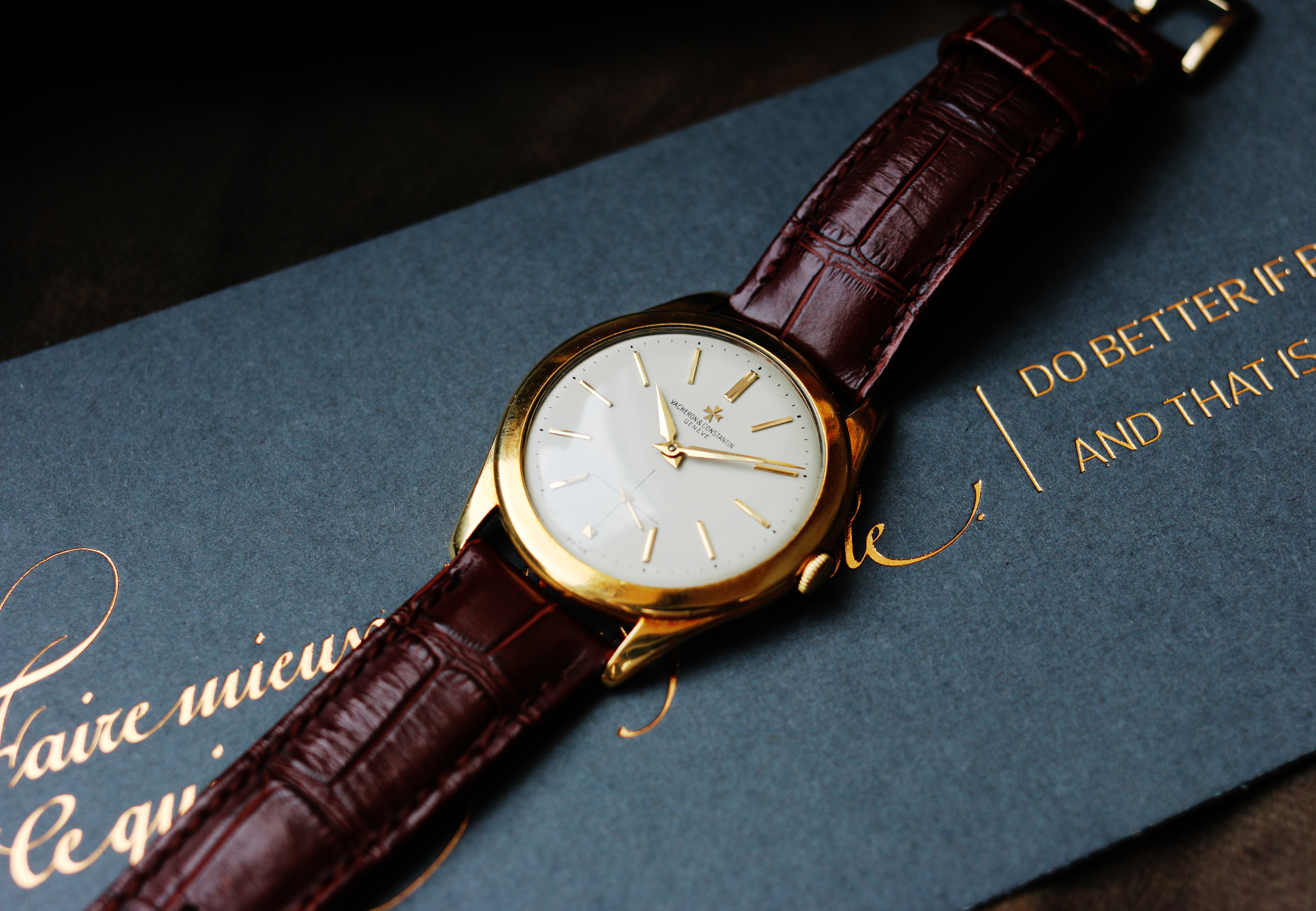
A later-production Vacheron & Constantin ref. 4600 of about 1957: a 36.8 mm gold dress watch with alpha hands, pearl-dot minute track, and calibre P453/3B, movement 521096.

Vacheron Constantin Ref. 4600, circa 1957, shown from the front on a dark brown presentation surface
Piece F / Collection photographc. 1957 / front view

Object study / moving image

A quiet
movement.

The video keeps the record close to the object: gold, crystal, dial and hands changing as the watch turns through natural light.

The ref. 4600 is restrained in construction but not anonymous in presence. Its broad bezel, pointed hands and cross-form seconds hand only resolve fully when the case moves.

This is a collection film, not a claim about the watch’s original presentation or service history.

Collection film / ref. 4600Natural light · object study

Photographic record / 01

The watch
in full.

The front-page sequence establishes the object before the research begins: scale, proportion, dial layout and the quiet confidence of the later 4600.

Photographic record / 02

The movement
underneath.

Movement 521096 is marked P453/3B: a 17-jewel, manually wound calibre built on the Jaeger-LeCoultre 449 ébauche and adjusted to five positions.

Photographic record / 03

The details
that stay.

Alpha hands, the subsidiary-seconds counterweight, the compact lugs and the presentation objects complete the visible record.

How to read it

01 / Identity

A circa-1957 Vacheron & Constantin reference 4600 in gold, about 36.8 mm across and 42 mm lug to lug. The ivory dial carries applied faceted indexes, a Maltese-cross emblem at twelve, a pearl-like minute track, alpha hands, and a cross-form subsidiary-seconds hand at six.

02 / Meaning

It is not one of the original 1949 Jubilé series of about 1,000 Holy Year watches. Movement 521096 and calibre P453/3B place it several years later, showing that the 4600 remained a successful large-format dress-watch design through the 1950s.

03 / Construction

Manual-winding calibre P453/3B, 17 jewels, based on the Jaeger-LeCoultre 449 ébauche. The movement measures about 28.8 mm by 4 mm, beats at 18,000 vph, and is adjusted to heat, cold, isochronism and five positions. The P prefix marks pare-choc shock protection.

Research / the record

The Quietly Complicated Story Of A 1957 Vacheron Constantin Ref. 4600

An oversized gold dress watch, an unusually expressive set of hands, and one of the great Jaeger-LeCoultre-based movements of mid-century Geneva.

Some watches make their importance obvious. They arrive with perpetual calendars, chronograph scales, tourbillons, or a famous name printed prominently across the dial. Others reveal themselves more slowly. At first, they seem almost too simple: a round case, three hands, a small-seconds register, and very little else.

This Vacheron & Constantin is one of the latter.

It is a large-for-its-time gold dress watch, publicly identified as a reference 4600 dating to approximately 1957. The watch measures about 36.8mm across and 42mm from lug to lug, dimensions reported by its former owner in a 2021 collector post. Those measurements sound ordinary today, but in the 1950s they gave the watch real presence. Many comparable dress watches of the period remained somewhere between 32mm and 35mm.

More unusual, however, is the dial. A restrained ivory surface is punctuated by applied faceted indexes, a Maltese-cross emblem at 12, a pearl-like minute track, and a wonderfully assertive pair of alpha hands. At six sits a subsidiary-seconds display with a delicate cross-form hand and a tiny diamond-shaped counterweight.

It is a watch assembled from very few visual elements, but almost every one of those elements has character.

01 / Chapter

A Different Kind Of Reference 4600

Reference 4600 is commonly associated with Vacheron Constantin’s “Jubilé” series. According to Antiquorum’s documentation, approximately 1,000 examples were produced in 1949 in several colors of gold, intended for sale around the Catholic Holy Year of 1950. These watches appear to have been directed primarily toward the Italian market.

The best-documented original Jubilé watches generally contain movements in the 484,000–485,000 range and use the P453/3C. One Antiquorum example carries movement number 484593 and case number 316666; a documented Bonhams example has movement number 485179, case number 317251, and is inscribed “Jubile” on the case.

The watch here is different. Its movement is numbered 521096 and is explicitly stamped P453/3B. Its established public history places it around 1957, several years after the original commemorative production.

This distinction matters because “Jubilé” has gradually become a convenient market nickname for almost every vintage ref. 4600. Auction houses and dealers have not always distinguished between the original 1949 commemorative series and the later watches that continued using the same reference.

The evidence suggests that this is best understood as a later-production ref. 4600 rather than one of the original 1,000 Holy Year pieces. That does not make it a lesser watch. In some ways, it makes it more interesting: it demonstrates that the 4600 was not merely a one-time anniversary model, but a successful large-format dress-watch design that Vacheron continued to reinterpret during the 1950s.

A closely comparable 1957 example was offered by Japanese vintage specialist Alpha Omega. It was described as a 36mm yellow-gold ref. 4600 with an ivory dial, alpha hands, pearl-dot minute track, calibre P453/3B, and a Vacheron Constantin archive document obtained in 2020. The configuration is strikingly close to the present watch and shows that this unusual combination of dial and hands belongs within the documented vocabulary of the reference.

02 / Chapter

The Importance Of The Alpha Hands

The hands are what first separate this 4600 from the many respectable but visually conservative Vacheron dress watches of the period.

Alpha hands begin broadly near the center, narrow sharply through their middle, and then expand into long pointed tips. Their geometry creates a sense of movement even when the watch is still. Here, their angular form contrasts with the softness of the round case and the nearly empty dial.

They are not an anachronistic embellishment. Vacheron used comparable alpha hands on several important watches during the early and mid-1950s, including the Chronomètre Royal ref. 4838. A documented 1953 example is described with yellow-gold alpha hands in the Collector Square and Antiquorum archives.

That comparison is significant. It places the hands within Vacheron’s established period design language and connects this relatively simple ref. 4600 to the more technically prestigious Chronomètre Royal family.

The subsidiary-seconds hand adds another layer. Instead of a conventional needle, Vacheron used a cross-shaped construction extending horizontally from the central axis. A small geometric counterweight sits beneath it. The result is decorative without becoming ornate, precisely the kind of detail that rewards inspection with a loupe but does not disturb the overall restraint of the dial.

04 / Chapter

Inside, The P453/3B

The movement is the heart of the watch’s appeal.

The photographs clearly show calibre P453/3B, movement number 521096, with 17 jewels. Its bridges are engraved:

Adjusted to heat, cold, isochronism and five positions.

That specification places it well above an ordinary commercial manual-wind movement. Positional adjustment attempted to minimize the rate changes occurring as the watch moved between dial-up, dial-down, crown-up, crown-left, and crown-right orientations. Adjustment for temperature and isochronism addressed changes caused by the balance spring, lubricants, and diminishing mainspring torque.

The P453/3B measures approximately 28.8mm in diameter and only 4mm thick. It runs at 18,000 vibrations per hour, or 2.5 Hz, and offers approximately 40 hours of power reserve. Its architecture includes subsidiary seconds, a Swiss lever escapement, a screw-regulated monometallic balance, an overcoil hairspring, shock protection, and a swan-neck fine regulator. The underlying JLC 449 specifications are recorded in the Ranfft movement database.

Visually, the movement is dominated by its long train bridge, sweeping across the center and exposing portions of the brass-colored wheel train below. Separate cocks support the balance and escape wheel. The bridges carry broad decorative stripes, while jewels sit in neatly finished countersinks. The polished swan-neck regulator provides a small area of mechanical sculpture beside the balance.

This individual movement does not show the Geneva Seal stamps found on certain higher-jewel executions. That should not be interpreted as a defect. The P453 family appeared in multiple specifications. Some later 18-jewel examples were Geneva Seal movements; this watch belongs to the 17-jewel P453/3B execution.

A Goldammer catalogue of Vacheron time-only movements places the 453 in production from 1942 to 1957 and distinguishes three common executions: the 453/2C (17 jewels, declined rim), the 453/3B (17 jewels), and the 453/3BW (18 jewels, Superchoc). Movement 521096 sits at the end of that documented window.

05 / Chapter

Jaeger-LeCoultre And Vacheron Constantin

The P453/3B was based on the Jaeger-LeCoultre calibre 449 ébauche.

To modern collectors, the use of an externally supplied base movement can appear inconsistent with the idea of haute horlogerie. In mid-century Switzerland, however, specialization was a normal and often desirable part of watch production.

Jaeger-LeCoultre was one of the industry’s great movement specialists. Vacheron acquired the base architecture and then applied its own bridge configuration, finishing, decoration, adjustment, assembly, and quality standards. Sotheby’s identifies the P453/3B as based on the JLC 449 in its description of a circa-1950 ref. 4600.

A detailed study of the relationship by Goldammer describes a collaboration that began around the late 1920s and continued for decades. Jaeger-LeCoultre supplied high-quality ébauches, while Vacheron transformed them into movements suited to its own watches. Goldammer notes that for much of the twentieth century this arrangement covered nearly the entirety of Vacheron’s serially produced output.

The distinction is important. The P453/3B is neither a completely independent Vacheron construction nor a lightly renamed stock JLC movement. It is the product of a period when haute horlogerie was frequently collaborative.

That collaboration extended into an entire movement family:

  1. The 453 provided subsidiary seconds.
  2. The 454 added indirect center seconds.
  3. The 485 and 495 developed the architecture into calendar movements.
  4. The 1007BS and 1008BS transformed it into a higher-grade, hacking chronometer platform for the Chronomètre Royal.

The surviving 453, 454, and 485 parts comparison reveals which components changed as the architecture evolved. An original-style JLC 449 technical sheet with exploded views also survives through the watchmaking-parts trade, providing the closest publicly accessible engineering documentation for the movement beneath the Vacheron finishing.

In a discussion cited by Quill & Pad, Vacheron specialist Bill Lind suggested that Philippe Dufour based the gear-train design of the Simplicity on the Jaeger-LeCoultre ébauche behind the 453. The claim remains a collector hypothesis, but it indicates how highly this long-bridge Vallée de Joux architecture is regarded.

06 / Chapter

The “P” In P453

The prefix “P” designates a movement fitted with pare-choc shock protection at the balance.

The balance-staff pivots in a mechanical watch are extremely small and vulnerable. A shock-protection system allows the balance jewel setting to move minutely under impact and return to its original position, reducing the likelihood of a broken pivot.

The same nomenclature appears elsewhere in the 453 family. A technical examination of the related Vacheron calibre P495 explains that the “P” indicates pare-choc balance protection.

It is a small letter that marks an important transition. By the 1950s, even an elegant gold dress watch was expected to tolerate the physical realities of daily wear.

07 / Chapter

What The Watch Tells Us About Vacheron In The 1950s

The ref. 4600 occupies an interesting position in Vacheron’s history. It is not a complication, not a certified Chronomètre Royal, and not one of the manufacture’s aggressively sculptural lug designs. Its value lies in execution.

It shows how Vacheron could take a relatively simple format and introduce distinction through proportion, typography, surface treatment, hands, and movement finishing. The 36.8mm case gives it an unexpectedly modern scale. The alpha hands provide tension. The cross-shaped seconds hand supplies a private flourish. Beneath the dial, the P453/3B demonstrates the level of adjustment and hand finishing that Vacheron was willing to apply to a time-only watch.

Collectors often concentrate on rarity measured through production numbers. This watch suggests another kind of rarity: the survival of a particularly coherent configuration.

The dial remains remarkably clean. The applied elements retain a consistent warmth. The movement appears well preserved and visually complete. The watch’s public history includes a reported service before its 2021 appearance, and its owner described it as an unusually well-cared-for example.

Absolute originality can only be established through the inside caseback, dial back, case numbers, and Vacheron’s records. The manufacture explains that an Extract from the Archives records the original characteristics associated with the case and movement numbers, while a full Certificate of Authenticity requires physical examination by its Heritage Department.

But even before those final archival questions are answered, the watch has already revealed its essential character.

It is a later ref. 4600, apparently dating to 1957, powered by one of the defining Vacheron movements of the post-war period. It belongs to the era when 36mm was oversized, when a small-seconds hand could become a piece of graphic design, and when collaboration between two great manufactures could produce something neither would have created alone.

The result is not loud, complicated, or immediately famous.

It is simply an exceptionally well-composed Vacheron Constantin—and sometimes that is more than enough.
08 / Chapter

The Maison Behind The Watch

Vacheron Constantin’s roots reach back to 1755, when Jean-Marc Vacheron established his workshop in Geneva. François Constantin joined the business in 1819, forming the partnership whose name would remain on the dial for the next century and a half. The company adopted the Maltese cross as its emblem in the nineteenth century, taking inspiration from a similarly shaped component formerly used to regulate the release of mainspring power.

By the time this ref. 4600 was produced, Vacheron had moved far beyond the model of a solitary cabinotier working in an attic workshop. Its watches emerged from a coordinated network of movement specialists, case makers, dial makers and hand makers, with Vacheron controlling the final design, finishing, adjustment and quality of the completed product.

The manufacture’s long relationship with Jaeger-LeCoultre was especially important. It allowed Vacheron to combine reliable, serially produced movement architecture with the elaborate adjustment and decoration expected of high Genevan watchmaking. The P453/3B inside this watch is one of the clearest expressions of that system: industrially rational beneath the surface, but individual in execution.

The company’s official historical timeline supplies the primary chronology for this background.

Related references

What the research
rests on.

  1. 01

    Antiquorum

    Ref. 4600 “Jubile”, movement 484593, 1949

    P453/3C, 17 jewels, 36 mm, case 316666. Records the original series of about 1,000 watches made in 1949 for the Holy Year of 1950, probably for the Italian market.

  2. 02

    Bonhams

    Jubilé, movement 485179, case 317251, 1949

    P453/3C, 17 jewels, 36 mm, case inscribed “Jubile.” A second documented original commemorative example.

  3. 03

    Alpha Omega

    Yellow-gold ref. 4600, 1957, Cal. P453/3B

    36 mm, ivory dial, alpha hands, pearl-dot minute track, archive document obtained in 2020. The closest published match to this configuration.

  4. 04

    Ranfft

    Jaeger-LeCoultre calibre 449

    28.8 mm, 4 mm high, 18,000 vph, about 40 hours of reserve. The ébauche beneath the P453/3B.

  5. 05

    Goldammer

    Jaeger-LeCoultre — Watchmaker of Vacheron Constantin

    Places the 453 in production from 1942 to 1957 and lists the /2C, /3B, and /3BW executions. Collaboration from the late 1920s into the late twentieth century.

  6. 06

    Sotheby’s

    Ref. 4600, pink gold, circa 1950

    Identifies the P453/3B as based on the Jaeger-LeCoultre 449.

  7. 07

    Quill & Pad

    Calibre P495 and the 453 family

    The prefix P marks pare-choc shock protection. Describes the long central bridge as Vallée de Joux architecture.

  8. 08

    Vacheron Constantin

    Heritage documents

    An Extract from the Archives records original case and movement characteristics. A Certificate of Authenticity requires physical examination.

  9. 09

    Reddit / r/Watches

    VC4600 from 1957, 2021 collector post

    Public measurements of about 36.8 mm and 42 mm lug to lug, with a reported service before the 2021 appearance.

A later ref. 4600

Not a Jubilé.
Still a 4600.

The original Jubilé series of about 1,000 watches was made in 1949 for the Holy Year of 1950, generally with P453/3C movements in the 484,000–485,000 range. This watch carries movement 521096 and calibre P453/3B, and belongs around 1957.

An Extract from the Archives would still settle the original case and movement characteristics. A Certificate of Authenticity requires physical examination by Vacheron’s Heritage Department. The visible record is already coherent: a large gold dress watch, alpha hands, and one of the defining post-war Vacheron movements.

Visible recordVacheron & Constantin
Periodc. 1957
DisplaySubsidiary seconds
WindingManual / P453/3B
Movement521096 / 17 jewels
Reference4600 / later production

Record

Vacheron & ConstantinRef. 4600c. 1957P453/3BMovement 52109617 jewels36.8 mm