Collection / Piece Cc. 1940 / Geneva movement, New York case

Vacheron & Constantin / pocket watch

Vacheron
& Constantin.

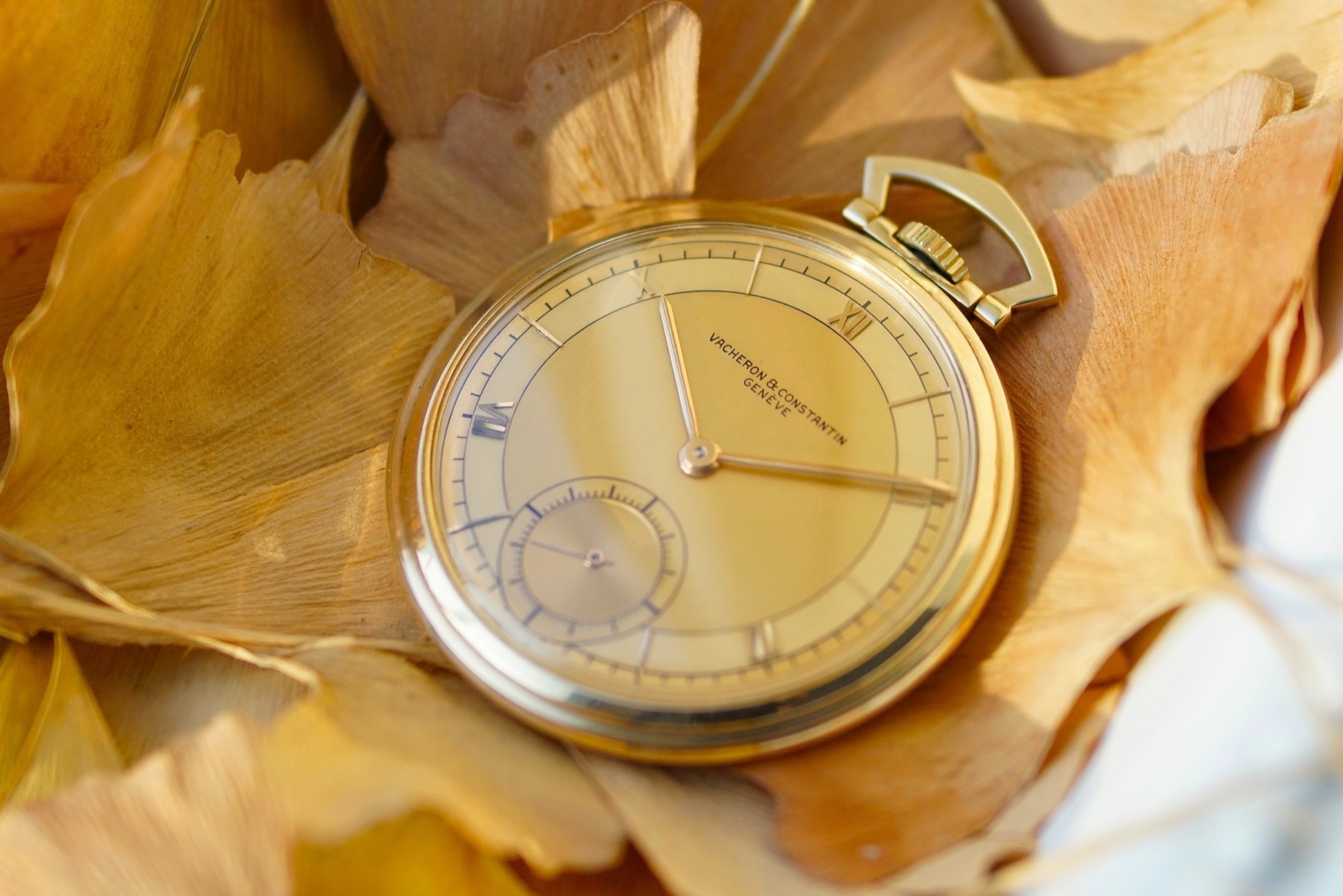
A circa-1940 Vacheron Constantin dress pocket watch: Calibre 439, movement 440101, finished in Geneva and cased in American fourteen-karat gold through Longines-Wittnauer.

Vacheron & Constantin pocket watch and chain arranged on handwritten archival paper
Piece C / Collection photographDial, chain, and archival paper

Research / the record

The Geneva Heart and the New York Case

A Circa-1940 Vacheron Constantin Pocket Watch, an American Fourteen-Karat Case, and the Intricate Commercial Network That Joined Genevan Watchmaking to New York Taste

In 1939, visitors converged on Queens to see the New York World’s Fair and its optimistic vision of the “World of Tomorrow.” Streamlined trains, television demonstrations, modernist architecture, and new consumer machines promised that the difficult years of the Great Depression were giving way to something faster and brighter.

Across the Atlantic, Europe was moving in the opposite direction. War began that September, and within two years the United States would enter it. Poised between these two worlds was New York’s luxury trade: Fifth Avenue showrooms and established jewelers still selling Swiss watches to bankers, doctors, industrialists, and families marking weddings, promotions, and anniversaries.

It was into this unsettled America that the present Vacheron Constantin appears to have arrived—not as a finished watch, but as a collection of Swiss components awaiting an American body.

Its movement was made and finished in Geneva. Its dial is marked “SWISS.” Yet the fourteen-karat case was almost certainly made in the United States and assembled through the American commercial organization controlled by Longines-Wittnauer.

The result is neither wholly Swiss nor merely American. It is a watch made between two worlds.

01 / Chapter

Dating the Watch

The first assumption might be that this pocket watch belonged to the 1950s. Its clean dial, slim construction, and restrained gold case could certainly suggest the postwar period. The serial numbers, however, tell a more precise—and more interesting—story.

The movement is numbered 440101. Christie’s has documented another Vacheron Constantin pocket watch, movement no. 439940, a mere 161 numbers earlier, as dating to circa 1940. That watch is also a fourteen-karat open-face model measuring 44 mm and powered by a seventeen-jewel movement. Christie’s documented movement no. 439940

Another Christie’s example, movement no. 454617, was confirmed by the Vacheron Constantin archives as having been manufactured in 1948. It used Calibre V 439 and was sent without a case to Vacheron Constantin New York. Christie’s 1948 archival example

Taken together, these comparisons place movement 440101 much closer to circa 1940 than to the 1950s. An extract from the Vacheron Constantin archives would be required for an exact year, but the available evidence points toward the opening years of the Second World War—perhaps just before the United States entered the conflict.

The watch therefore emerged at a transitional moment. The wristwatch had already become the practical modern choice, but the thin gold pocket watch retained a particular social role. It was no longer an essential machine carried by every working man. It was becoming a deliberate dress object: discreet, formal, and slightly ceremonial.

02 / Chapter

The Watch Itself

The dial commands immediate attention. Its champagne-gilt surface is divided into concentric sectors, with an open central field, a contrasting hour chapter, and a finely printed peripheral minute track.

Applied gold Roman numerals mark the quarters, while elongated markers occupy the remaining hours. The subsidiary seconds register at six o’clock is engine-turned with tightly concentric grooves, producing a restrained texture that becomes fully visible only when light moves across the surface.

The faceted gold hands are long and exceptionally thin. Everything is arranged to emphasize diameter without visual weight.

This is not a railroad watch, a military watch, or an instrument intended to announce itself from across a room. It belongs to the category traditionally described as a dress pocket watch. Its visual language is architectural but quiet: the residue of Art Deco refined into something calmer and more modern.

Inside is a large manual-winding Vacheron Constantin movement from the Calibre 439 family. Comparable versions of the 17-ligne Calibre 439 measure approximately 37.75 mm in diameter and only about 3.5 mm in thickness. The movement operates at a traditional 18,000 vibrations per hour and offers approximately forty hours of power reserve.

Its observable specifications comprise manual winding; seventeen jewels; a Swiss straight-line lever escapement; a bimetallic compensation balance; a Breguet overcoil balance spring; adjustment to temperature; a swan-neck micrometer regulator; and small seconds at six o’clock.

The movement is decorated with broad Geneva-style striping and signed:

Vacheron & ConstantinGenèveSeventeen 17 JewelsAdj. to Temp.Swiss

Near the balance is the small American import code VXN. That code is an important clue: it identifies a movement imported through the American channel used for Vacheron Constantin and LeCoultre under the Longines-Wittnauer organization.

The movement is therefore not Longines-made. It is a Vacheron Constantin movement imported to America through a commercial system administered by Longines-Wittnauer.

03 / Chapter

How a Geneva Movement Acquired an American Body

The back of the case discloses its transatlantic nature.

The case is marked with the Vacheron Constantin name, the Maltese cross, 14K, and case no. 692291. It does not display the Swiss squirrel hallmark normally associated with Swiss fourteen-karat gold cases, nor does it carry an immediately visible mark identifying a known Swiss case maker.

In isolation, that absence would not establish American manufacture. A remarkably close archival comparison, however, does.

Christie’s description of a 1948 Vacheron Constantin pocket watch records a Calibre V 439, seventeen jewels, and a 43.5 mm fourteen-karat American-made circular case with a stepped bezel, a snap-on back, and a case stamped V&C. According to the Vacheron Constantin archives, that movement was manufactured in Switzerland and sold without a case to Vacheron Constantin New York.

That statement effectively documents the production route. Vacheron was sending Calibre 439 movements across the Atlantic uncased, after which its American organization placed them inside locally manufactured fourteen-karat cases.

The present watch follows almost exactly the same formula.

The probable sequence of production was as follows:

  1. Vacheron Constantin manufactured and finished movement 440101 in Geneva.
  2. A Swiss dial—and probably the corresponding hands—was prepared for it.
  3. The movement was exported to the United States under the VXN import code.
  4. Vacheron Constantin New York, working within the Longines-Wittnauer organization, procured an American fourteen-karat case.
  5. The case was manufactured by a specialist American contractor and stamped for Vacheron.
  6. The watch was cased, timed, inspected, and released into the American jewelry trade.

It was a Vacheron Constantin conceived in Geneva and completed for America in New York.

04 / Chapter

Did Longines Design the Case?

Here the story becomes more nuanced.

It would be misleading to say that Longines manufactured this case in its Swiss factory. It would also be premature to claim that Vacheron Geneva supplied a complete technical drawing and instructed Longines to reproduce it exactly.

The more probable answer lies between those two possibilities.

Longines-Wittnauer was not simply another Swiss watch manufacture operating alongside Vacheron. In the United States it functioned as an extensive commercial organization with knowledge of American tariffs, pricing, retailers, advertising, local component suppliers, and consumer taste.

A historical study of Longines’ international business found that Wittnauer selected cases, dials, and straps when completing Longines watches for the American market. It understood which materials, dimensions, and styles American jewelers could sell. Academic history of Longines’ American production system

That does not prove it exercised complete design control over Vacheron products. Vacheron’s reputation depended upon maintaining a distinct identity, and the Genevan manufacture would almost certainly have retained approval over anything carrying its name.

More plausibly, the arrangement was collaborative: Vacheron supplied the movement and core aesthetic identity; Vacheron established the necessary dimensions and quality level; the New York organization determined that the watch should be housed in a slim fourteen-karat case suited to the American luxury market; Longines-Wittnauer or Vacheron New York selected an appropriate pattern from an American case supplier; the supplier adapted it for Calibre 439 and applied Vacheron’s internal signatures; and Vacheron approved the completed product.

The circular body, stepped bezel, snap back, and geometrical open bow were not exclusive Longines designs. They belonged to a shared vocabulary of American dress watches. Case manufacturers could offer standard or semi-custom patterns to several brands, altering the bow, bezel, crown, internal dimensions, and markings for each client.

This explains why the case resembles contemporary Longines and Wittnauer watches. The similarity may not be evidence that Longines’ Swiss design studio drew the watch. It may instead reveal a shared American supplier, a common New York product office, or simply the same understanding of what an elegant American dress watch should look like.

The most accurate description is therefore:

Vacheron designed the watch’s identity; Longines-Wittnauer helped translate that identity into an American product; an American specialist made the case.
05 / Chapter

Why Vacheron Worked with Longines-Wittnauer

Vacheron maintained an American corporate presence, but it did not construct a fully independent national organization.

A 1954 federal court decision provides unusually direct evidence. It describes the American Vacheron company as a wholly owned and controlled subsidiary of Longines-Wittnauer. Longines carried its accounts, handled its finances, and, from 1939 through 1949, advertised and sold its imported products through the Longines sales force. Even after Vacheron received a separate sales staff in 1949, that staff was paid by Longines. Mastercrafters v. Vacheron & Constantin

Period advertisements eventually used the remarkable formulation:

Vacheron & Constantin–LeCoultre Watches, Inc.Division of Longines-Wittnauer Watch Company

For a small, prestigious manufacture such as Vacheron, the arrangement was economically rational.

The American market demanded relationships with hundreds of independent jewelers, national advertising, customs administration, case suppliers, spare-parts inventories, repair facilities, trained watchmakers, and credit extended to retailers across an enormous country.

Longines-Wittnauer already possessed that infrastructure.

Instead of duplicating an expensive national network for a relatively small number of high-priced watches, Vacheron could retain its Genevan manufacture while using Longines-Wittnauer’s American commercial apparatus. Fondation Haute Horlogerie characterizes this period as a shared commercial structure in which Swiss movements were imported uncased and completed in locally made cases. Fondation Haute Horlogerie

This was less a creative partnership between the Longines and Vacheron factories than an alliance between Swiss prestige and American distribution power.

06 / Chapter

A Pocket Watch for the Breast Pocket?

The watch’s slenderness alters how one imagines it being worn.

At approximately 43–44 mm, it is substantial enough to read easily, yet its movement and snap-back case were constructed to remain comparatively flat. It lacks the bulk of a traditional railroad watch or large hunting-case watch.

A waistcoat pocket with a conventional T-bar chain would have remained the most historically familiar arrangement. But this watch does not demand a long, decorative Albert chain. Its slim case also makes an interior breast pocket entirely plausible, secured with a shorter chain or guard attached to a buttonhole or lapel.

That would yield a more discreet mode of wear: the watch resting flat inside the jacket’s breast pocket; a short section of chain visible near the lapel or buttonhole; no heavy chain stretched across the waistcoat; the watch withdrawn vertically for a quick reading.

We cannot prove that Vacheron designed this specific model exclusively for the breast pocket. Nevertheless, its proportions support the interpretation. It feels less like a Victorian pocket watch carried as equipment and more like a private dress accessory—something concealed within a tailored jacket rather than displayed across it.

Its thinness was not merely technical elegance. It altered the social presence of the object.

07 / Chapter

The Gold That Escaped the Furnace

A plain fourteen-karat pocket watch also faces an uncomfortable historical reality: at various moments, its case can become more valuable as metal than the complete watch appears to be as an object.

Fourteen-karat gold is roughly 58.5 percent fine gold. When pocket watches fell out of daily use, countless examples became unfashionable family possessions. A movement might require service, the crystal might be damaged, and the resale market might value the complete object at less than the recoverable metal in its case.

Successive bullion surges intensified that pressure. The dramatic rise culminating in 1980, the renewed market around 2011, and the sustained escalation of gold prices into the mid-2020s each encouraged the dismantling of older jewelry and watches.

This is not merely retrospective speculation. In June 2026, Reuters reported that vintage gold watches were again being scrapped when their recoverable gold exceeded their resale value. Dealers described complete Swiss luxury watches being dismantled for their cases. Reuters on the renewed melting of vintage gold watches

There are no surviving production figures sufficient to call this watch one of only a particular number remaining. Nor should rarity be manufactured through rhetorical inflation. Other American-cased Calibre 439 pocket watches are known.

But survival itself remains significant.

This watch appears to have passed through more than eight decades without being separated into a movement, dial, and scrap-gold case. It survived the decline of the pocket watch, the rise of inexpensive wristwatches, the quartz revolution, several gold-price booms, and generations in which an unfashionable pocket watch was often valued primarily by weight.

Perhaps it survived because the Vacheron name was recognized. Perhaps someone understood the quality of the movement. Or perhaps its preservation had nothing to do with horology at all.

Perhaps it survived because of two letters.

08 / Chapter

What Might “S.P.” Mean?

Without provenance, “S.P.” cannot be expanded into a documented name.

If the letters appear as a deliberately engraved exterior monogram, personal initials are the most probable explanation. If they are small and scratched inside the case, they may instead be a watchmaker’s service mark. Less likely possibilities include a company abbreviation, a presentation code, or a property identifier.

The responsible historical answer ends there.

A more speculative, human answer may extend a little further.

One may imagine an owner in New York around 1940—someone with the initials S.P.—receiving the watch for a wedding, a promotion, a professional achievement, or a milestone that once seemed important enough to mark in gold.

Perhaps it was purchased before America entered the war, when the future still felt uncertain but ordinary life continued. Perhaps it sat in the breast pocket of a dark suit, fastened by a short chain and consulted in offices, railway stations, hotel lobbies, and candlelit restaurants. Perhaps its owner never knew that the movement had crossed the Atlantic without a case, or that the gold shell around it represented an improvised partnership between Geneva and New York.

The initials may have belonged to the buyer. They may have belonged to the person for whom it was bought. They may even represent someone the owner wanted to remember.

That is only a romantic possibility, not provenance. But the letters could explain something that serial numbers cannot: why this particular gold watch was kept intact when so many others were dismantled.

09 / Chapter

A Watch Made Between Two Worlds

Judged only as a mechanical object, this is a beautifully preserved Vacheron Constantin dress pocket watch with a high-grade Calibre 439-family movement, temperature adjustment, a compensation balance, and a finely constructed sector dial.

Its greater significance lies in its divided origin.

The movement records Geneva’s technical culture. The VXN mark records its passage through American customs. The fourteen-karat case reflects American tariffs, suppliers, and consumer preferences. The Longines-Wittnauer connection reveals the commercial infrastructure required to carry an old Genevan name across a modern continent.

It is not a Longines movement in a Vacheron disguise, nor merely a Swiss Vacheron placed randomly into an aftermarket shell. The evidence points toward an organized American-market production system—one authorized by Vacheron and administered through Longines-Wittnauer.

Geneva gave the watch its face and its heartbeat.

New York chose the body in which America would encounter it.

And somehow, through war, changing fashion, mechanical obsolescence, and repeated temptations to reduce it to the value of its gold, the watch remained whole.

Detail pictures / 23 plates

Slide the object.

A closer look at this watch. Click the plate to enlarge, or choose a frame from the strip.

01 / IMG 3153

Related references

What the research
rests on.

  1. 01

    Christie's

    Movement no. 439'940, circa 1940

    A 14K open-face Vacheron Constantin, 44 mm, seventeen jewels. The nearest published serial to 440101.

  2. 02

    Christie's

    Movement no. 454'617, manufactured 1948

    Calibre V 439, sold without a case to Vacheron Constantin New York. Documents the American-casing route.

  3. 03

    S.D.N.Y. 1954

    Mastercrafters v. Vacheron & Constantin-Le Coultre

    119 F. Supp. 209. Records Vacheron as a Longines-Wittnauer subsidiary, with Longines handling finance, advertising, and sales from 1939.

  4. 04

    Fondation Haute Horlogerie

    The Quirky Backstory of LeCoultre in the USA

    Uncased Swiss movements assembled locally under Longines-Wittnauer; period ads for Vacheron & Constantin–LeCoultre Watches, Inc.

  5. 05

    1stDibs

    Longines-Wittnauer 14K, 44 mm, Cal. 17L

    A thin American-market Longines-Wittnauer open-face pocket watch in the same 44 mm dress vocabulary.

  6. 06

    Antiquorum

    Longines open-face extra, circa 1940, lot 60

    Geneva, 14 May 2017. Two-tone dial, 18K pink gold, 46 mm. A contemporary Longines dress pocket watch.

01 / What it is

A Vacheron Constantin dress pocket watch with a champagne sector dial, applied Roman numerals, subsidiary seconds, and a fourteen-karat American case. The movement, numbered 440101, belongs to the Calibre 439 family and was imported under the VXN code.

02 / Why it remains

It is a watch made between two worlds: a Genevan heart completed for New York taste. Survival matters as much as origin. The case was never melted, and the letters S.P. remain.

03 / Inside

A manual-winding Calibre 439-family movement, seventeen jewels, swan-neck regulator, and temperature adjustment, housed in an American 14K case numbered 692291. The dial is marked SWISS; the movement is not Longines-made.

Record

Vacheron & Constantinc. 1940Calibre 439 familyMovement 44010114K American case 692291VXN import17 jewels