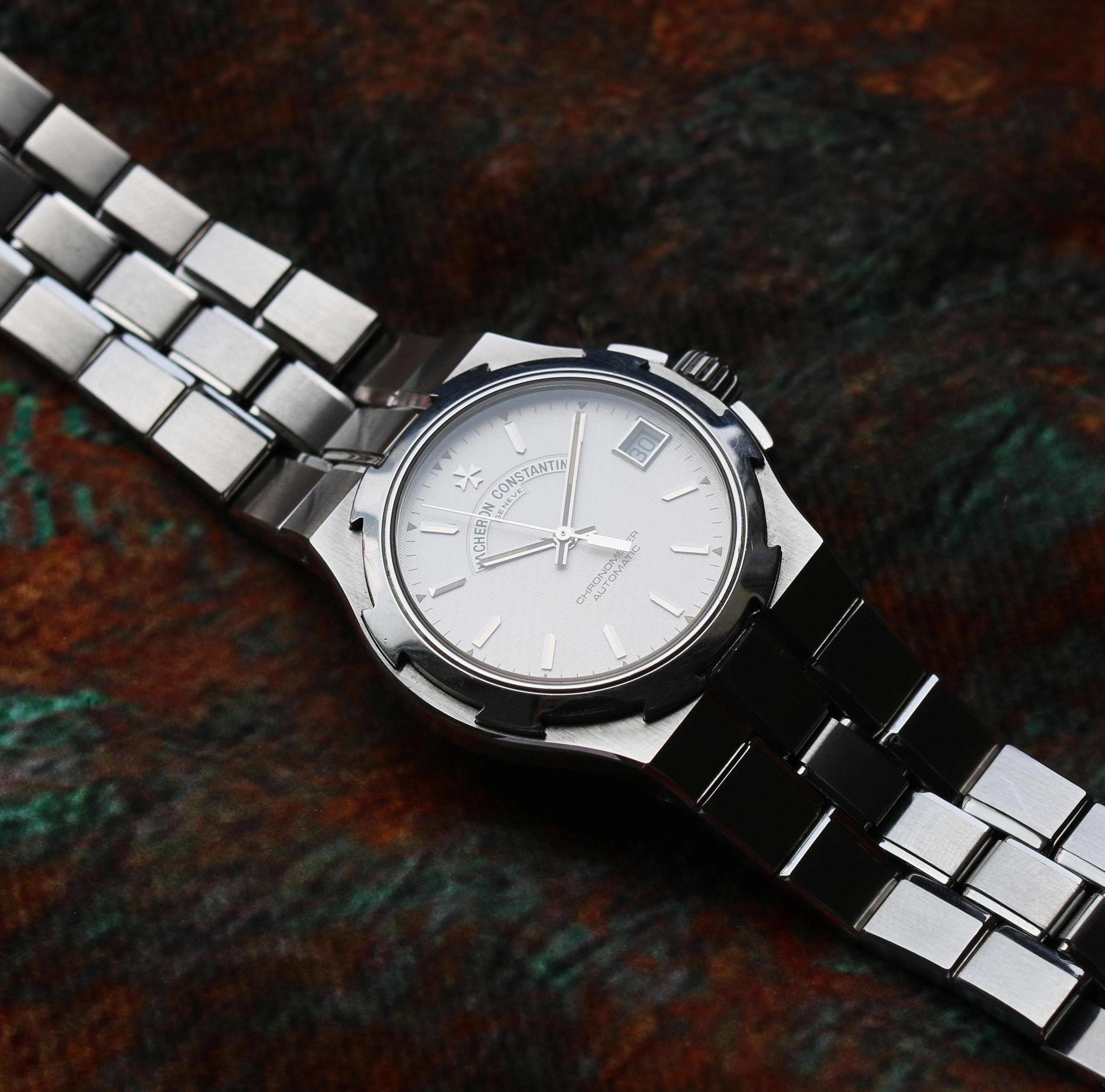
Vacheron Constantin / Overseas 42050
Vacheron
Overseas.
A 35 mm first-generation Vacheron Constantin Overseas, reference 42050: COSC-certified ultra-thin calibre 1310, 150 metres of water resistance, and the original 1990s integrated bracelet.
Research / the record
The Original 35mm Vacheron Constantin Overseas Is A Small Watch With A Surprisingly Serious Movement
The ref. 42050 may be the compact member of the first Overseas family, but with a COSC-certified ultra-thin calibre, 150 metres of water resistance, and some wonderfully excessive 1990s bracelet engineering, it is hardly the lesser watch.
There is a tendency to describe the first-generation Vacheron Constantin Overseas as the third participant in a competition that had already been decided.
Audemars Piguet had the Royal Oak. Patek Philippe had the Nautilus. Vacheron Constantin had arrived late with the 222, disappeared into the stylistically uncertain 1980s, and returned in 1996 with something called the Overseas. From a distance, the story seems straightforward: another integrated-bracelet sports watch from another member of Switzerland’s so-called Holy Trinity.
The 35mm Overseas ref. 42050 on my wrist tells a more interesting story.
It is not quite vintage, not remotely modern, and not really a miniature version of anything. At 35mm, it belongs to a moment when a serious men’s sports watch could still be compact without requiring an explanation. Its white guilloché-pattern dial, muscular crown guards, polished Maltese-cross bezel and intricately finished bracelet give it far more visual presence than its diameter suggests.
Underneath all that steel is an ultra-thin, 4Hz automatic movement with quick-set date, hacking seconds and genuine COSC chronometer certification. It is also a movement with some particular maintenance requirements, housed in a watch whose bracelet can be simultaneously beautiful, frustrating and expensive to put right.
That combination is precisely what makes the 42050 compelling. It is wonderfully refined, genuinely capable and just imperfect enough to feel like a product of ambitious mechanical watchmaking rather than luxury product management.
01 / Chapter
Before The Overseas
The familiar starting point is Vacheron Constantin’s ref. 222, introduced in 1977 for the company’s 222nd anniversary. It had an integrated bracelet, a thin tonneau-shaped case and a notched circular bezel, with a small Maltese cross set into the case at five o’clock.
The 222 is still frequently misattributed to Gérald Genta. Its actual designer was a young Jörg Hysek, who was reportedly only in his early twenties when he created it.
Inside was Vacheron’s calibre 1120, derived from the legendary Jaeger-LeCoultre 920 architecture also used, in modified form, by Audemars Piguet and Patek Philippe. The 222 remained in production until the mid-1980s, followed by the angular 333 and then the rounder, unmistakably late-1980s Phidias.
When Vacheron began developing the Overseas, however, the company was not attempting to reproduce the 222.
Vacheron heritage director Christian Selmoni has explained that the Maison does not consider the Overseas a direct evolution of the 222. The objective was broader: to find a contemporary expression of sport and elegance within Vacheron Constantin. Steel was essential, but so were refinement, thinness and unmistakable house identity. WatchTime’s detailed history
The first Overseas was created by external designer Dino Modolo and Vacheron Constantin’s Vincent Kaufmann, who would later lead the Maison’s design department. Hysek supplied the historical foundation through the 222; Modolo and Kaufmann designed the watch that actually carried the Overseas name.
Their design turned the Maltese cross from an applied emblem into architecture. Eight polished recesses cut into the bezel evoke the cross’s eight points without reproducing it literally. Around that bezel sits a broad tonneau case with vertically brushed surfaces, polished edges and substantial crown guards. An integrated bracelet continues the mixture of brushed planes and polished facets.
The result is related to the 222, but it is not a copy. It is sharper, more mechanical and distinctly more 1990s.
02 / Chapter
The First Overseas, In Two Sizes And Two Calibres
The first-generation Overseas family was produced from 1996 until 2004. Its central automatic references divide neatly on paper:
- Ref. 42040: 37mm, calibre 1310
- Ref. 42042: 37mm, calibre 1311
- Ref. 42050: 35mm, calibre 1310
- Ref. 42052: 35mm, calibre 1311
The ref. 42050 shown here is the early 35mm execution, normally identified in stainless steel as 42050/423A. It measures approximately 35mm without its crown and guards and around 8.5mm thick. It has a sapphire crystal, screw-down crown, solid engraved caseback and an original water-resistance rating of 150 metres.
That last figure matters. This was not a thin dress watch given an integrated bracelet for visual effect. It was engineered as a proper sports watch, complete with a substantial crown assembly and a sealed caseback engraved with the three-masted ship associated with Amerigo Vespucci.
The smaller case is not visually timid. Because the measurement excludes the projecting crown guards and because the bracelet begins at the full width of the case, the watch occupies more of the wrist than a conventional round 35mm watch. Its highly articulated surfaces also catch far more light than its dimensions would suggest.
The most useful collector study of these references remains Ben Dunn’s extensive Watch Brothers London guide, which documents the movement changes, dial signatures, clasp designs and numerous transitional irregularities within the first generation.
03 / Chapter
A White Dial Unlike The Others
Vacheron offered the early Overseas with white, blue, black, grey and rosy-beige or “salmon” dials. There were also rare black and blue Arabic-numeral versions with matte surfaces.
The white dial is not the rarest, but it may be the most elaborate.
While the coloured dials generally received sunray finishes, the white dial was decorated with a tightly repeating guilloché-style pattern. It creates a surface that can appear silver, cream or nearly white depending on the angle of the light. The texture is sufficiently fine that it does not immediately announce itself, but once seen, it prevents the dial from ever looking flat.
At twelve is a separately applied Maltese cross. Below it, “Vacheron Constantin Genève” follows the curvature of the dial rather than sitting in a conventional straight line. “Chronometer Automatic” appears above six in a comparatively severe technical typeface.
Long applied markers point toward triangular luminous plots in the chapter ring. The hands follow the same geometry: squared at their bases, sharply pointed at their ends and divided by narrow strips of luminous material. The date aperture at three is deeply framed and contains an old-fashioned serif date wheel.
Early examples can be found with Sigma signatures and tritium, followed by “T SWISS MADE T” dials and eventually “SWISS MADE” Luminova executions. These changes do not correspond perfectly with the movement revisions. Old dial stock continued to be used, and later service dials complicate the chronology further.
Consequently, the only reliable way to establish whether a watch is a true 42050 rather than a visually identical 42052 is to examine the case reference and movement.
04 / Chapter
The Girard-Perregaux Movement Vacheron Made Its Own
The calibre 1310 was not designed from a blank sheet of paper at Vacheron Constantin. Its underlying architecture was Girard-Perregaux’s GP 3100, part of an ultra-thin automatic family introduced in 1994.
The GP 3100 measured approximately 25.6mm across and only about 3mm thick. Vacheron acquired the base movement, modified and finished it, fitted its own gold rotor execution, adjusted it and submitted each movement for COSC chronometer testing.
The resulting calibre 1310 offered:
- Automatic winding
- 27 jewels
- 28,800 vibrations per hour
- Approximately 45 to 46 hours of power reserve
- Quick-set date
- Central seconds
- Hacking seconds
- COSC chronometer certification
It is easy to dismiss supplied movements when discussing modern haute horlogerie, but that judgment misunderstands both the period and the movement itself. Girard-Perregaux was not supplying Vacheron with a generic mass-market calibre. The GP 3100 was an advanced, exceptionally thin manufacture architecture that Girard-Perregaux also used as a foundation for its own watches and complications.
Vacheron’s contribution lay in its specification, finishing, regulation and certification. It was a collaboration between two high-level Swiss manufacturers, not a prestigious name disguising an inexpensive engine.
05 / Chapter
A Chronometer That Can Actually Be Synchronized
The word “Chronometer” on the dial is not decorative.
For traditional mechanical certification, COSC tested each uncased movement over 15 days, in five positions and at three temperatures. The historical average daily-rate requirement was between minus four and plus six seconds per day. COSC’s certification standard
The 1310 also hacks. Pull the crown into the time-setting position and the seconds hand stops, allowing the watch to be synchronized precisely to a reference signal.
Hacking seconds was hardly unknown in 1996, but combining it with an approximately 3mm-thick automatic calibre, a quick-set date, 4Hz frequency and chronometer adjustment was meaningful. Many celebrated ultra-thin movements sacrificed practical conveniences in pursuit of thinness.
Nearly 30 years later, this particular watch remains remarkably accurate. That does not mean its original COSC certificate somehow guarantees its performance forever. It means that the underlying balance, escapement and gear train were sufficiently well constructed—and subsequently sufficiently well maintained—that the watch can still perform close to its original purpose.
There is something satisfying about an old chronometer that continues to behave like one.
06 / Chapter
The Price Of Being Ultra-Thin
The calibre 1310’s thinness was also the source of its most important weakness.
The GP 3000 and 3100 family used a lubricated steel ball bearing for the automatic rotor. Over time, the small quantity of oil in that bearing can age, migrate or dry out. Prolonged storage does not necessarily prevent this; old oil can become sticky even while the watch is sitting still.
When lubrication deteriorates, friction increases and the balls and bearing races begin to wear. The rotor can develop lateral or vertical play, allowing it to wobble instead of rotating in a controlled plane. If ignored, it may contact the bridges or inside of the caseback and introduce metallic particles into the movement.
Technical histories of the GP 3000 family identify the lubricated steel rotor bearing as a known vulnerability. Girard-Perregaux later developed ceramic ball bearings that did not require conventional lubrication, specifically to address problems associated with aged oil, wear and contamination. GP 3000 movement history
In practice, this is why an early 1310 deserves closer attention than its continuing accuracy might suggest. A watch can keep excellent time while its rotor bearing is beginning to dry or loosen. Rate performance tells you about the regulating organ; it does not certify the health of the automatic winding system.
For a frequently worn 42050, inspection approximately every three to five years is sensible, particularly if the rotor becomes louder, feels loose or produces a scraping sensation. A watchmaker should inspect the bearing, rotor clearance, automatic train and reverser wheels rather than simply applying fresh oil to a worn component.
There was another structural concern. According to the research assembled by Watch Brothers London, the extremely thin 1310 could experience flex in its mainplate. Vacheron responded with the strengthened calibre 1311, adding approximately 0.3mm of thickness without materially changing the case.
That revision changed the 35mm reference from 42050 to 42052. The 42050 is therefore not simply an earlier number. It represents Vacheron’s original, thinner and slightly more ambitious mechanical solution before the company quietly reinforced it.
07 / Chapter
A Beautiful Bracelet That Demands Compromise
The first-generation bracelet is one of the best parts of the watch.
Its rectangular links alternate broad brushed surfaces with narrow polished facets. The articulation allows the steel to move fluidly around the wrist, while the mixture of finishes gives the bracelet an almost jewel-like appearance. It is more intricate than it first looks and substantially contributes to the watch’s visual presence.
It can also be remarkably difficult to size perfectly.
Unlike the current Overseas, the first-generation bracelet has no usable on-the-fly micro-adjustment. Removing or installing a full link can leave the watch alternating between slightly too tight and noticeably too loose—particularly as the wrist changes size through heat, exercise or the course of a day.
For someone seeking a genuinely precise fit, the practical solution is to obtain the appropriate shorter or “half” links from Vacheron Constantin and use a combination of full and shorter links to position the clasp correctly beneath the wrist. Collector measurements suggest that these shorter links are closer to roughly two-thirds the length of a normal link than a mathematical half, allowing more useful sizing combinations.
Original loose links are not reliably available through the secondary market, and the 35mm and 37mm bracelets do not necessarily share identical dimensions. Ordering the correct link through Vacheron Constantin—using the complete case and bracelet reference—is therefore the safest route.
It is a small but potentially expensive detail that should be considered when purchasing a 42050. A watch offered on a short bracelet may not merely require “one more link.” It may require the correct combination of full and short factory links before it becomes genuinely comfortable.
08 / Chapter
Be Gentle With The Clasp
Early first-generation Overseas watches were commonly equipped with an elaborate slide-lock clasp combined with a Maltese-cross-shaped secondary safety cover. The mechanism uses multiple locking actions rather than behaving like a conventional stamped friction clasp.
It feels substantial, but it should not be forced.
If the clasp resists opening, applying brute force to the Maltese-cross cover can bend, loosen or damage the more delicate locking components beneath it. The correct release sequence matters. The safety and trigger should be disengaged before the clasp is lifted; the cover should never be treated as a lever for overcoming a mechanism that remains locked.
Watch Brothers London notes that the early slide-lock arrangement was considered fiddly and became responsible for a number of service problems. Toward the end of production, Vacheron replaced it with a more conventional butterfly clasp.
Replacement components for the early clasp are now extremely difficult to obtain independently. A damaged example may require factory intervention or replacement through Vacheron Constantin, assuming the necessary parts remain available. Buying a random period clasp is not a reliable solution because bracelet widths, link constructions and clasp generations vary.
The safest approach is preventative: learn the opening sequence, keep the mechanism clean, stop if it does not release normally, and never allow an unfamiliar person to pry it open by force.
09 / Chapter
The 35mm Question
A 35mm luxury sports watch will inevitably be described as “mid-size,” but that label is less informative than it sounds.
The 42050’s effective wrist presence is enlarged by its tonneau case, crown guards and integrated bracelet. There are no conventional lugs narrowing the transition between watch and strap. The first bracelet links visually extend the case, while the polished bezel draws a large, bright circle around the dial.
The result is compact but not delicate.
The design also benefits from the smaller scale. The eight polished bezel recesses appear deeper and more architectural. The white dial remains dense without becoming crowded. At roughly 8.5mm thick, the watch slips beneath a cuff while retaining enough steel around its dial to feel purposeful.
Modern enthusiasts have spent years rediscovering that integrated sports watches do not need to be 41 or 42mm to have presence. The 42050 did not need to rediscover anything. It simply comes from the period before those proportions were abandoned.
10 / Chapter
The Imperfect Original
It would be easy to romanticize the 42050 as a forgotten alternative to the Nautilus and Royal Oak. But its appeal is more specific than relative price or Holy Trinity hierarchy.
This watch captures Vacheron Constantin at a transitional moment. The company was emerging from the uncertain post-quartz years, entering new ownership and attempting to define what a modern Vacheron sports watch should be. Its designers did not simply reproduce the 222. Its watchmakers did not insist that a respectable movement had to begin life entirely within Vacheron’s walls. Instead, the company selected one of the finest ultra-thin automatic architectures available, transformed it into a chronometer and installed it in a remarkably thin 150-metre case.
Some compromises came with that ambition.
The original movement required reinforcement. The steel rotor bearing demands attention as its lubrication ages. The bracelet has no micro-adjustment and may require factory half links before it fits properly. The elaborate early clasp rewards careful handling and punishes force. Replacement parts are neither plentiful nor inexpensive.
None of those things diminishes the watch. They explain it.
The first-generation Overseas is a product from a time when luxury sports watches were still being mechanically and aesthetically negotiated. The 42050 is the more compact, thinner and arguably more revealing version of that experiment.
Thirty years later, mine still hacks cleanly, winds properly and keeps chronometer-worthy time. Its white dial changes with the light, its bracelet feels more elaborate than many modern replacements, and its 35mm case looks neither apologetic nor obsolete.
It is not a smaller approximation of the Overseas.
It is the original idea, compressed to its most elegant form.
Bound album / Movement · 20 frames
Service sequence · frame 01
Service sequence · frame 02
Service sequence · frame 03
Bound album / Regular light · 16 frames
Studio sequence · frame 01
Studio sequence · frame 02
Studio sequence · frame 03
Related references
What the research
rests on.
- 01
WatchTime
Overseas Mission: The History and Evolution of the Vacheron Constantin OverseasSelmoni on the Overseas as a contemporary expression of sport and elegance rather than a direct evolution of the 222. Modolo and Kaufmann as the designers of the first generation.
- 02
Watch Brothers London
First-generation Overseas: refs. 42040, 42042, 42050, 42052Ben Dunn’s collector study of movement changes, dial signatures, clasp designs, half links, and the 1310-to-1311 revision.
- 03
COSC
Chronometer certification standardFifteen days, five positions, three temperatures. Historical average daily-rate requirement of −4 to +6 seconds per day.
- 04
Watch-Wiki
Girard-Perregaux GP 3000 familyThe lubricated steel rotor bearing as a known vulnerability, and GP’s later ceramic bearing as the remedy.
- 05
Wikimedia Commons
Vacheron Constantin Historiques 222Clyde94’s photograph of the later Historiques 222, used here as a visual of Hysek’s 1977 design.
- 06
Watch Wiki
Jörg HysekBiography of the 222’s designer, with the RD3 Complication portrait used in the first chapter.
Record