Collection / Piece HFirst Omega in Space

Omega / Speedmaster FOIS

The First Omega
In Space.

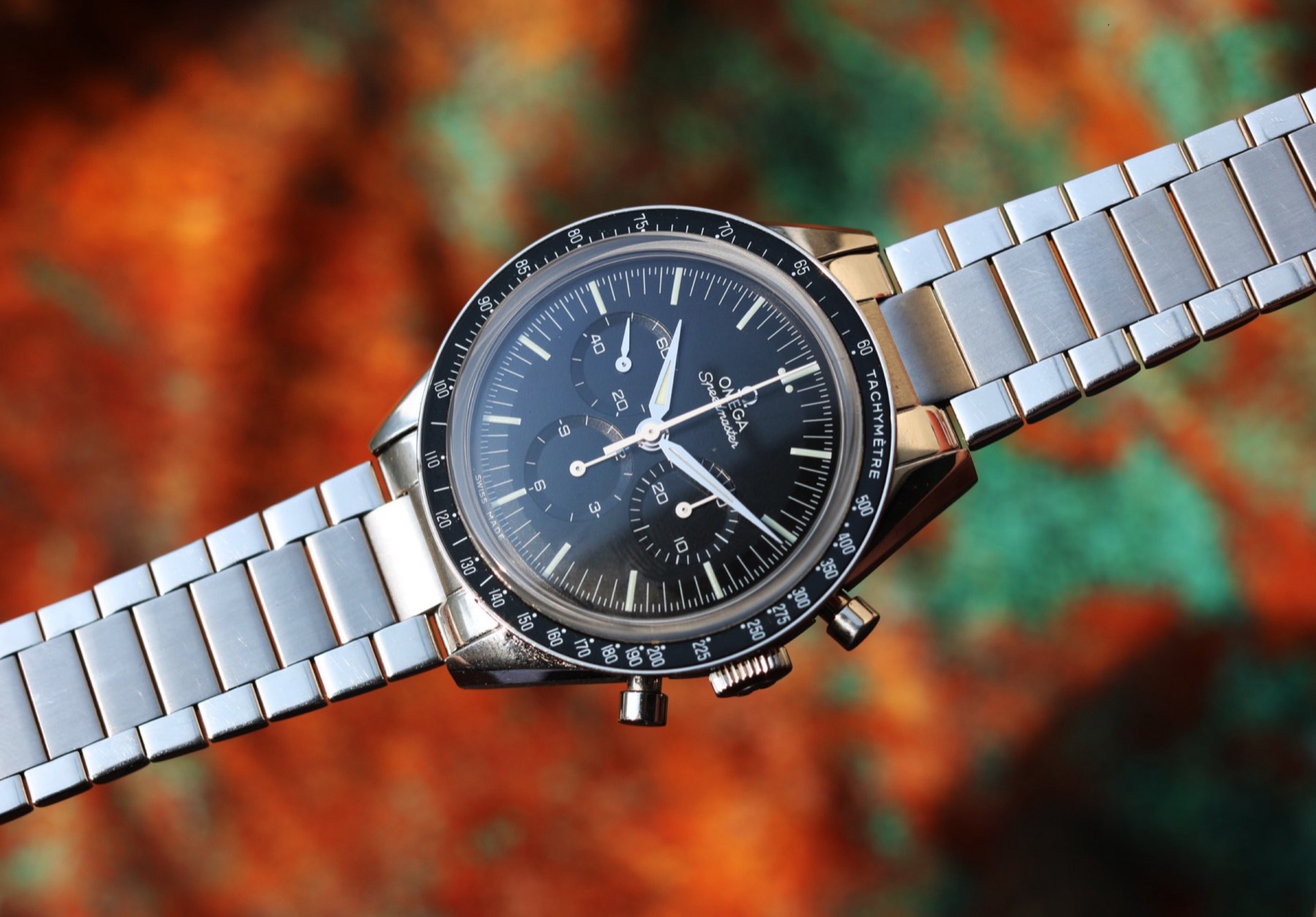
The first-generation Speedmaster “First Omega in Space,” reference 311.32.40.30.01.001: a 39.7 mm straight-lug tribute to Wally Schirra’s personal CK2998, photographed here on a Forstner flat link with a slim Spiralwinder exhibition back over calibre 1861.

Omega Speedmaster FOIS chronograph photographed from the front with its black dial and steel case
Piece H / Collection photographRef. 311.32.40.30.01.001

Research / the record

The First Omega In Space, Reconsidered

How a compact, overlooked Speedmaster—and two thoughtful aftermarket additions—connect Wally Schirra, Swiss industrial watchmaking, NASA’s chronograph trials, and the last generation of Omega’s calibre 1861

There is a tendency, when discussing the Omega Speedmaster, to begin at the Moon.

This is understandable. The Moon is a powerful place to begin a story. It offers grainy television images, white spacesuits against black space, and a mythology so complete that the watch has almost ceased to be a mechanical object. It has become the Moonwatch: one word, one icon, one very effective marketing narrative.

The watch photographed here tells a quieter and, in some respects, more interesting story. This is the first-generation Omega Speedmaster “First Omega in Space,” reference 311.32.40.30.01.001. Introduced in 2012 and discontinued in 2020, it commemorates not the Moon landing, not NASA’s formal qualification trials, and not even a spacewalk. Instead, it returns to the moment before all of that—when a naval aviator and test pilot named Walter “Wally” Schirra privately chose an Omega Speedmaster and carried it into orbit.

This particular example has moved even further away from the standard catalogue configuration. Its original brown leather strap has been replaced by a Forstner flat-link bracelet, while its commemorative solid caseback has given way to an unusually slim sapphire exhibition back from Spiralwinder Watch Parts.

Neither component is made by Omega. Yet both make historical and mechanical sense. The result is not an exact re-creation of Schirra’s watch, nor should it be understood as one. It is something more layered: a modern collector’s interpretation of several different periods in Speedmaster history.

01 / Chapter

Before the Moonwatch

The Speedmaster was not designed for astronauts.

Introduced in 1957 as the reference CK2915, it emerged alongside the Seamaster 300 and Railmaster as part of Omega’s new family of specialized professional watches. Pierre Moinat, head of Omega’s creative department, worked with designer Claude Baillod on a robust chronograph intended for drivers, engineers, scientists, athletes, and what contemporary advertising called “men who reckon time in seconds.”

Its defining innovation was the placement of the tachymeter scale on the external bezel rather than around the edge of the dial. This created more room for a highly legible three-register display while allowing a driver to calculate average speed over a known distance. The Speedmaster name was therefore literal before it became cosmic.

The original CK2915 carried a brushed steel bezel and broad-arrow hour and minute hands. In 1959, Omega replaced it with the CK2998. The second-generation watch introduced the black aluminium bezel, slender alpha-shaped hands, and the visual language that would eventually inspire the watch seen here.

A useful overview of these formative references can be found in Phillips’ examination of three early Speedmasters, while the collector-oriented Speedmaster101 CK2998 guide documents the often bewildering succession of dash references, hands, bezels, crowns, pushers, and serial ranges.

The CK2998 was still a terrestrial instrument. Its black dial may now evoke a spacecraft panel, but it was originally part of Omega’s language of speed, measurement, and machinery. Space entered the story because the right watch happened to meet the right owner.

02 / Chapter

Wally Schirra’s private choice

On October 3, 1962, Wally Schirra entered orbit aboard Mercury-Atlas 8. He named his capsule Sigma 7: sigma for the summation of engineering effort behind the mission, and seven for the original Mercury astronauts.

Schirra completed six orbits in 9 hours, 13 minutes, and 15 seconds. At the time, it was the longest American orbital mission yet undertaken. Its purpose was largely technical—evaluating the Mercury spacecraft, conserving propellant, testing control modes, and photographing Earth—not staging the kind of dramatic public spectacle later associated with Apollo.

On Schirra’s wrist was his personal Omega Speedmaster CK2998. It was not issued by NASA, and the agency had not yet subjected the Speedmaster to formal qualification. Schirra was a test pilot carrying a chronograph he had selected for himself. NASA’s official Sigma 7 history provides the mission context.

This made the CK2998 the first Omega in space, but the wording requires precision. It was not the first wristwatch in space; Yuri Gagarin had worn a Soviet Sturmanskie during Vostok 1 in April 1961. Nor was Schirra’s flight a spacewalk. He remained inside Sigma 7 throughout the mission.

The exact dash reference of Schirra’s watch has historically attracted some disagreement. Omega now identifies it as a CK2998-4, although older photographic scholarship sometimes left open the possibility of a -4 or -5. The surviving watch and Omega’s archival research support the -4 attribution, but early Speedmasters are an area in which apparently simple certainties can unravel under inspection. Bezels, hands, crowns, and pushers were routinely replaced during service, and production boundaries were not always clean.

The exact retailer from which Schirra bought his watch is also less securely documented than the modern story sometimes implies. The fact that it was a personal watch is well established. The familiar tale of a particular Houston jeweller should be treated with more caution.

03 / Chapter

The NASA story was a separate event

Schirra’s personal preference did not automatically make Omega NASA’s official watch.

By 1964, the Gemini and Apollo programs required a dependable wrist chronograph. NASA engineer James Ragan helped define the requirements and manage the evaluation. Contrary to the popular anecdote that NASA employees secretly bought several watches from a local store, the agency issued a formal request to American watch distributors.

Four companies responded. Hamilton reportedly submitted a large marine or pocket chronometer rather than the requested wristwatch and was eliminated. Three wrist chronographs entered testing:

  • Omega’s Speedmaster ST105.003
  • Rolex’s reference 6238, now known as the “Pre-Daytona”
  • Longines-Wittnauer’s reference 235T

For years, the identities of the losing watches were obscured by rumour. The Rolex was often described as a Daytona, while the Longines-Wittnauer candidate was frequently claimed to be the exotic 242T. Correspondence preserved in Omega’s archives instead identifies the Rolex 6238 and Wittnauer 235T. This account of the surviving archival documents is particularly useful.

The watches were exposed to high and low temperatures, thermal cycling in vacuum, humidity, pure oxygen, shock, acceleration, decompression, pressure, vibration, and acoustic noise. This was not a beauty contest, nor did the Omega emerge completely unaffected. Published test summaries indicate that its luminous material deteriorated and that its rate shifted substantially during portions of the program. What mattered was that it continued to operate satisfactorily after the competing chronographs suffered terminal failures.

Ragan also recalled that the astronauts preferred the Speedmaster independently of the laboratory results because it was easier to read and operate. His recollections, recorded in a detailed interview on the NASA qualification process, are more informative than the compressed version of events found in most advertisements.

NASA’s qualification is conventionally dated March 1, 1965, although the precise administrative chronology is more complicated: report completion, final testing, procurement, and the June 1 public announcement are not necessarily the same milestone. Gus Grissom and John Young were already wearing NASA Speedmasters during Gemini 3 on March 23.

On June 3, Ed White wore a Speedmaster ST105.003 outside his suit during Gemini 4, becoming the first American to walk in space. He was not the first human to do so—Alexei Leonov had left Voskhod 2 on March 18—but White’s photographs established the visual relationship between the Speedmaster and the American space program. The Smithsonian notes that Omega chronographs were subsequently worn throughout Gemini and that the Speedmaster remains the watch certified for NASA EVA work in its Outside the Spacecraft exhibition.

The important distinction is that Schirra’s CK2998 and NASA’s ST105.003 represent two related but independent chapters. The first was a private test pilot’s choice. The second was a government qualification conducted with a later Speedmaster reference.

04 / Chapter

The watch Omega made in 2012

Half a century after Sigma 7, Omega returned to Schirra’s watch with the first-generation FOIS.

Reference 311.32.40.30.01.001 reproduced the early Speedmaster’s 39.7mm diameter, symmetrical case, straight lugs, exposed crown and pushers, and polished bevels. A black anodized-aluminium bezel carried a base-500 tachymeter scale, while the dial abandoned the “Professional” designation and restored an applied Omega logo.

The watch was substantially smaller in visual mass than the 42mm Speedmaster Professional, although its approximately 48mm length meant it was not necessarily shorter on the wrist. More importantly, it lacked the Professional’s protective asymmetrical case and twisted lyre lugs. It appeared sharper, simpler, and more closely related to the racing chronograph of 1957.

Omega did not make an exact replica. The original CK2998 used a Hesalite crystal, while the FOIS received a raised box-form sapphire crystal. Its varnished black dial lacked the pronounced outer step of vintage examples. The aluminium bezel used a contemporary dot-next-to-90 configuration rather than the collector-favoured “dot over 90.” Its luminous material was modern Super-LumiNova rather than radium.

The hands formed another deliberate departure. The polished alpha hour and minute hands were joined by a polished alpha- or leaf-shaped running-seconds hand at nine o’clock. The central chronograph seconds hand and the hands of the 30-minute and 12-hour recorders were painted white.

This arrangement separates ordinary timekeeping from chronograph information: polished metal for the time and white for the stopwatch. It is visually coherent, but it does not exactly reproduce Schirra’s CK2998. Contemporary Omega records indicate that his watch used straight register hands. Hodinkee’s original side-by-side examination of the FOIS and CK2998 discusses this discrepancy.

The original caseback was equally modern. It carried a large embossed hippocampus, the words “THE FIRST OMEGA IN SPACE,” the date “OCTOBER 3, 1962,” and an individual edition number. The watch was numbered but never formally limited; Omega announced no maximum production quantity.

Production continued from 2012 until late 2020. Estimates of approximately 15,000–16,000 watches are based on observed edition numbers rather than an official Omega disclosure. The most useful account of the model’s production and discontinuation is Monochrome’s first-generation FOIS retrospective.

The discontinuation coincided with the end of calibre 1861 production and the arrival of the co-axial calibre 3861. In hindsight, the FOIS belongs as much to the final 1861 period as it does to the early CK2998.

05 / Chapter

The calibre behind the window

The sapphire caseback in the photographs reveals Omega’s calibre 1861, a movement never intended to be displayed in this particular watch.

It is a 27mm, hand-wound, integrated chronograph with 18 jewels, a frequency of 21,600 vibrations per hour, and a power reserve of approximately 48 hours. Its chronograph is controlled by a cam-and-shuttle system and uses lateral coupling. It has neither automatic winding nor stop-seconds and was never a chronometer or METAS-certified movement.

The 1861 is often described as a descendant of the calibre 321, but it should not be mistaken for a lightly modified version. The original 321 was a lower-frequency, column-wheel chronograph derived from the Lemania CH27 family. In 1968, Omega replaced it with the Lemania 1873-based calibre 861, which used cam switching and ran at a faster 21,600 vph.

The 861 was less romantic but better suited to dependable serial manufacture. Its simpler control system reduced production and servicing costs, while its higher frequency offered greater stability in everyday use. The rhodium-plated 1861 succeeded it during the 1990s and powered the standard Moonwatch until 2020.

This movement did not take Schirra into orbit, qualify for NASA in 1965, or land with Apollo 11. Those achievements belong to calibre 321 watches. The later calibre 861 was tested again for the Space Shuttle program in 1978, giving the 861/1861 architecture a legitimate space-program history of its own.

Through the display back, the 1861 looks honest rather than luxurious. It has stamped levers, functional bridge shapes, conventional screws, visible synthetic and steel components, and none of the ornamental refinements associated with a high-end display chronograph. Omega’s closely related calibre 1863 was cosmetically finished for exhibition-back Speedmasters and used a metal chronograph brake largely for visual reasons. The 1861 instead uses a low-friction Delrin brake.

That synthetic component is sometimes criticized by enthusiasts because plastic appears incompatible with romantic ideas of traditional watchmaking. Mechanically, however, it is a sensible solution: light, self-lubricating, inexpensive, and well suited to stopping the chronograph wheel without damaging its fine teeth.

The beauty of the 1861 lies in observing the mechanism’s logic rather than elaborate hand-finishing. Starting the chronograph moves the shuttle, engages the lateral coupling, and sets a series of plainly visible levers into motion. It is a durable industrial machine with more than 230 components, designed to work and to be serviced for decades. Its specifications can be consulted in the WatchBase calibre 1861 entry.
06 / Chapter

A bracelet with several histories

Omega delivered the first-generation FOIS only on a 19mm brown leather strap. According to contemporary reporting, this was an intentional decision; in 2012, Omega did not have an appropriate modern flat-link bracelet for the case.

The Forstner bracelet fitted to this example corrects that absence convincingly. Its broad brushed centre surfaces, polished outer elements, thin links, and strong taper recall Omega’s early flat-link bracelet family:

  • Reference 7077/6, approximately 1957–61
  • Reference 7912/6, approximately 1961–66
  • Reference 1506/16, approximately 1964–66
  • Reference 1039/516, approximately 1966–72

Depending on its precise production and delivery date, an original CK2998-4 could plausibly be found with either a 7077/6 or 7912/6. The later 1039 became particularly associated with Apollo-period Speedmasters.

Forstner’s recreation is constructed from solid 316L stainless steel, with solid end pieces, screw-adjusted links and spring-loaded links that provide a small degree of expansion. Its FOIS configuration tapers from 19mm at the lugs to 16mm at the clasp. The company’s flat-link product page documents its construction and fitment.

It is worth correcting a frequent attribution. The famous Swiss bracelet manufacturer was Gay Frères—not “Gray Freyes”—but there is insufficient evidence to describe this particular Forstner as a Gay Frères homage. Forstner presents it as a reinterpretation of Omega’s vintage flat-link bracelets.

Forstner’s more direct astronaut association concerns the narrow Komfit mesh bracelet and its successor, the JB Champion. These expandable mesh bracelets were widely used by NASA personnel and astronauts. Collector analysis of photographs suggests that Schirra wore a Forstner/JB-style mesh bracelet during portions of his training but used a different stretch bracelet during Sigma 7 itself.

The flat link on the photographed watch is therefore historically appropriate to an early catalogue Speedmaster, but not an exact copy of Schirra’s flight bracelet. A Komfit would make a more explicit NASA reference; the flat link creates a stronger connection to the CK2998 as an Omega product.

It also transforms the watch aesthetically. On leather, the FOIS can appear like a vintage-inspired dress chronograph. On the flat link, it regains the industrial character of the original Speedmaster—a precision instrument designed to live among machinery.

07 / Chapter

Making a thick watch thinner

The second modification is made by Spiralwinder Watch Parts. Its caseback uses a precision-machined 316L stainless-steel outer ring, a polished double bevel inspired by pre-Moon Speedmasters, sandblasted tool slots, and a scratch-resistant sapphire crystal with colourless multilayer anti-reflective treatment.

More importantly, it reduces total height by over one millimetre.

That change addresses one of the first-generation FOIS’s least-discussed compromises. Although the watch was only 39.7mm across, its factory thickness was approximately 14mm. The solid commemorative back contributed significantly to that height. Replacing it with the slim Spiralwinder back allows the case to sit lower and makes its straight-lug profile feel more proportional.

The modification is reversible, but not without implications. The factory back contains the watch’s individual number and commemorative identity. Any original internal cover, gasket, or movement-support component removed during installation should be preserved with it.

A third-party caseback may also alter magnetic shielding, movement support, and water resistance. The watch’s original 50-metre rating should not simply be assumed after installation. A pressure test performed on the completed watch is the only meaningful confirmation.

Nevertheless, the combination works. The 1861 fills the sapphire window with levers, wheels, jewels, and the oscillating balance. Because the back is so thin, the movement appears immediately beneath the glass rather than at the bottom of a deep metal well. The polished outer bevel also echoes the straight lugs in a way that appears visually intentional.

08 / Chapter

A hybrid rather than a replica

The first-generation FOIS has sometimes been criticized for failing to reproduce the CK2998 accurately enough. That criticism is technically valid but historically incomplete.

Omega in 2012 was not the Omega of 2024. The company had not yet recreated calibre 321. The standard Moonwatch still used calibre 1861. Stepped dials, dot-over-90 bezels, vintage-shaped sapphire crystals, and compact flat-link bracelets had not yet been systematically restored across the Speedmaster collection.

The FOIS arrived before the 2017 Trilogy Speedmaster, the modern “Ed White” calibre 321, the redesigned 3861 Moonwatch, and the second-generation FOIS. It was the watch that reopened the straight-lug, pre-Professional branch of Speedmaster design for a modern audience.

The new FOIS introduced in 2024 is objectively more elaborate. It has a blue-grey CVD-coated stepped dial, a historically styled DON aluminium bezel, a sapphire crystal shaped to resemble Hesalite, a revised straight-lug case, calibre 3861, and an optional Omega flat-link bracelet. It is thinner, more accurate, strongly resistant to magnetism, and Master Chronometer certified.

But the first generation has acquired a character the new model cannot reproduce. It belongs to the final era of the old Moonwatch engine. It remains individually numbered. Its black dial and white lume are less theatrical than the new model’s deliberately aged colour palette. And its imperfections document a particular stage in Omega’s rediscovery of its own archive.

The example photographed here makes that transitional nature explicit. Its case and alpha hands evoke the CK2998. Its Forstner bracelet references Omega’s early flat links. Its exposed calibre 1861 represents the long industrial era that followed calibre 321. Its Spiralwinder back reflects the modern enthusiast community’s desire to participate in the design of a watch rather than merely preserve its factory configuration.

It is not the watch Schirra wore.

It is not the watch NASA tested.

It is not the watch Ed White exposed to vacuum or Buzz Aldrin carried onto the lunar surface.

Instead, it is a modern Speedmaster built around the moment when those histories were still separate—when the Speedmaster was simply a very good chronograph chosen by a very serious pilot.

That may be the most compelling part of the FOIS story. Before Omega owned the mythology, Schirra chose the watch.

Collector’s specifications

First generation.
Last 1861.

Individually numbered, never limited. A 39.7 mm straight-lug Speedmaster built around the moment before the Moonwatch, photographed here on a Forstner flat link with a slim Spiralwinder exhibition back.

ModelOmega Speedmaster “First Omega in Space”
Reference311.32.40.30.01.001
Production2012–late 2020
EditionIndividually numbered, not limited to a declared quantity
Estimated productionApproximately 15,000–16,000; unofficial collector estimate
CaseStainless steel, symmetrical straight-lug construction
Diameter39.7mm
LengthApproximately 47–48mm
Factory thicknessApproximately 14mm
Lug width19mm
CrystalBox-form sapphire
BezelBlack anodized aluminium, base-500 tachymeter
DialVarnished black, recessed subdials, applied Omega logo
MovementOmega calibre 1861, hand-wound integrated chronograph
Frequency21,600 vph
Jewels18
Power reserveApproximately 48 hours
Factory water resistance50 metres
Original strapBrown calfskin
Bracelet photographedForstner 19mm flat link, 316L stainless steel
Caseback photographedSpiralwinder 316L steel and AR-coated sapphire exhibition back

Hasselblad / A12 / 12 frames

Magazine
A12.

Schirra trained with a Hasselblad on Sigma 7. The A12 back holds twelve exposures. Wind the magazine — one uncropped plate at a time.

HasselbladA1201/12

Dial

Tachymeter / alpha hands

Related references

What the research
rests on.

  1. 01

    NASA

    Schirra Orbits the Earth Six Times Aboard Sigma 7

    Official mission history of Mercury-Atlas 8: six orbits, 9 hours 13 minutes, a personal CK2998 on the wrist.

  2. 02

    Smithsonian

    Wally Schirra’s NASA-issued Gemini 6 Speedmaster

    The later issued watch, distinct from the private CK2998 he carried on Sigma 7.

  3. 03

    Smithsonian

    Omega and EVA history

    Outside the Spacecraft: Omega chronographs worn throughout Gemini; the Speedmaster still certified for NASA EVA.

  4. 04

    Smithsonian

    Neil Armstrong’s Apollo 11 Speedmaster

    The Moonwatch chapter the FOIS deliberately does not begin with.

  5. 05

    Revolution

    James Ragan on NASA’s qualification program

    The engineer behind the 1964–65 trials: formal requests, laboratory failures, and why the astronauts preferred the Speedmaster.

  6. 06

    Fratello

    The Rolex and Longines-Wittnauer watches tested by NASA

    Archival identification of the Rolex 6238 and Wittnauer 235T, against years of rumour.

  7. 07

    Speedmaster101

    CK2998 collector reference

    Dash references, hands, bezels, crowns, pushers, and serial ranges for the second-generation Speedmaster.

  8. 08

    Phillips

    Three early and genre-defining Omega Speedmasters

    CK2915, CK2998, and the formation of the professional chronograph before space.

  9. 09

    Hodinkee

    First-generation FOIS compared with the CK2998

    The 2012 tribute beside Schirra’s watch, including the register-hand discrepancy.

  10. 10

    Monochrome

    Production and discontinuation of the first-generation FOIS

    2012–2020, unofficial edition-number estimates, and the end of calibre 1861.

  11. 11

    CollectSPACE

    Omega’s original 2012 FOIS announcement

    The first-generation tribute as introduced for the fiftieth anniversary of Sigma 7.

  12. 12

    Forstner

    Flat-link bracelet for the first-generation FOIS

    Solid 316L, 19-to-16 mm taper, screw and spring links.

  13. 13

    Spiralwinder

    Sapphire exhibition caseback for the calibre 1861 FOIS

    Slim 316L ring, double bevel, AR-coated sapphire; more than a millimetre of height removed.

  14. 14

    WatchBase

    Omega calibre 1861 specifications

    27 mm, 18 jewels, 21,600 vph, cam-and-shuttle chronograph, about 48 hours.

01 / What it is

A first-generation Omega Speedmaster FOIS, reference 311.32.40.30.01.001, produced from 2012 to late 2020. It commemorates Schirra’s private CK2998 on Sigma 7, not NASA’s later qualification or the Moon landing. This example wears a Forstner 19 mm flat-link bracelet and a Spiralwinder sapphire exhibition back.

02 / Why it remains

It is a hybrid rather than a replica: CK2998 case language, an early Omega flat-link idea, the last industrial 1861, and a modern collector’s caseback. Before Omega owned the mythology, Schirra chose the watch.

03 / Inside

Hand-wound Omega calibre 1861: 27 mm, 18 jewels, 21,600 vph, cam-and-shuttle chronograph, lateral coupling, about 48 hours. The factory solid back has been replaced by a slim 316L and AR-sapphire exhibition ring that lowers the 14 mm case by more than a millimetre.

Record

Omega Speedmaster FOIS311.32.40.30.01.0012012–2020Calibre 186139.7 mm / 19 mmForstner flat linkSpiralwinder exhibition back