01 / Identity
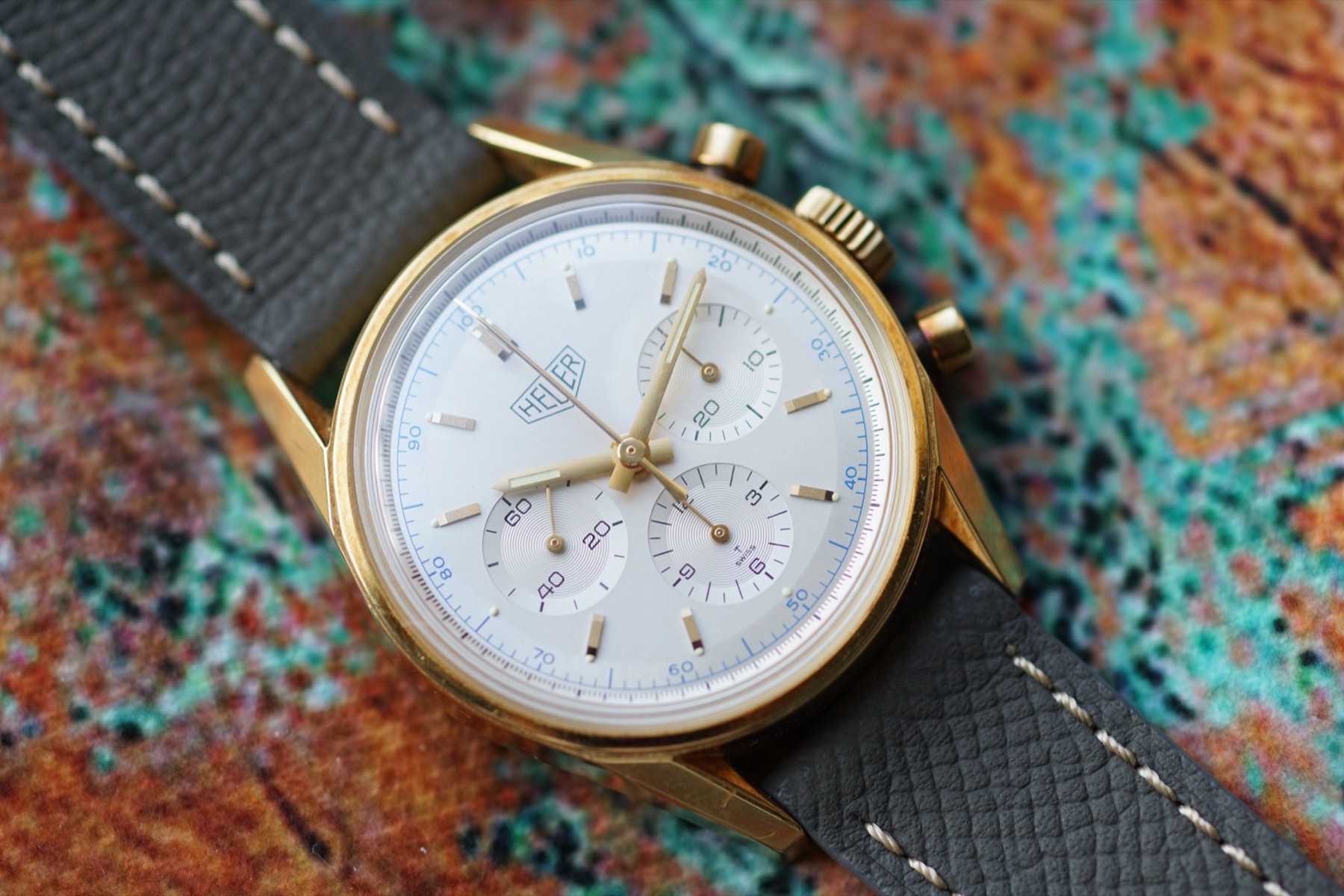
The Heuer Carrera CS3140, introduced in 1996 as the solid-gold member of the first Carrera re-edition family. This photographed example is stamped CS3140 and individually numbered No. 0765.
A personal collection
The Collector’s Guide / Heuer Carrera CS3140
It looks every inch like a watch from 1963. It is, in fact, the remarkably faithful 1996 re-edition that reopened one of Swiss watchmaking’s most important chapters—and this solid-gold example is the rarest expression of the idea.
First, get the reference right
Heuer Carrera CS3140 · 18k yellow gold · 1996
There is a small trap hidden in this watch, and it has caught more than a few auction listings.
At first glance, the ingredients appear to settle the question. There is the old Heuer shield, a sharply faceted gold case, a silver dial divided into three recessed registers, and a fine blue decimal scale circling the edge. Nothing says TAG Heuer. Nothing says modern. Even the acrylic crystal catches the light like a watch that has spent sixty years moving through the world.
But the Heuer Carrera CS3140 is not an original 1960s Carrera. It is something more unusual: an 18k-yellow-gold re-edition introduced in 1996, when TAG Heuer decided to recover a part of its past that had been absent from the catalogue for years.
This example leaves no ambiguity. Its caseback is stamped CS3140 and individually numbered No. 0765. Inside is a hand-wound Lemania 1873, not the Valjoux 72 of the first-generation Carrera. Its dimensions, materials, and dial design were chosen to make a new watch feel uncannily like an old one—at a time before ‘heritage re-edition’ had become an industry category.
The distinction is not a technicality. It is the key to understanding why the watch matters.
01 / Chapter
Heuer had been making timing instruments long before it began making watches people would collect by reference number. Founded by Édouard Heuer in 1860, the company built its reputation around stopwatches, chronographs, and dashboard timers. Its important 1887 patent refined the oscillating pinion, a compact mechanism for engaging a chronograph that remains part of mechanical watchmaking today.
That instrument-making background matters because the Carrera was not designed as a decorative chronograph. When Jack Heuer joined the family company in 1958, his attention was already fixed on information: how quickly it could be found, how clearly it could be read, and how little visual material was needed to communicate it.
In 1962, at the 12 Hours of Sebring, Jack heard the name of the Carrera Panamericana, the notoriously dangerous Mexican road race held from 1950 to 1954. Carrera could mean a race, a road, a course, or a career. He registered the name and introduced the first Heuer Carrera in 1963.
The watch that followed was built around subtraction. The dial was clean, the registers large, and the case simple except for its long, sharply bevelled lugs. Most cleverly, the timing scale was moved from the flat dial to an angled tension ring beneath the acrylic crystal. The ring helped secure the crystal, but it also opened the dial and tilted its smallest markings toward the wearer.
The Carrera became a racing chronograph without relying on the usual theatre of a racing watch. Its sense of speed came from how efficiently it delivered information.
02 / Chapter
The lineage of the CS3140 is best understood as a family tree rather than a straight line.
Its clearest dial ancestor is the 1963 Carrera reference 2447D, whose ‘D’ identified a decimal-minutes scale. That scale divides a minute into 100 units rather than 60 seconds. One decimal unit therefore represents 0.6 seconds, allowing time to be recorded in hundredths of a minute for rally calculations, industrial work, or other forms of technical timing. The original 2447D was normally made in stainless steel.
The genuine solid-gold Carrera of the period was reference 2456, an 18k, three-register, hand-wound chronograph powered by the Valjoux 72. It supplied the historical precedent for a precious-metal Carrera, although its dial was not an exact match for the blue decimal display seen here.
Then there was the 2448D, whose gold-plated case and decimal dial brought the two ideas visually closer together—but gold plate is not solid gold.
Reference correctionThe CS3140 is a 1996 solid-gold re-edition, not an original ‘1964 gold Carrera.’ The period solid-18k Carrera is reference 2456; the decimal dial derives principally from references 2447D and 2448D.
The CS3140 combines these strands. It has the 18k substance associated with the 2456 and the decimal-dial architecture of the 2447D and 2448D. It is not a one-for-one remake of a single vintage reference. It is a historically coherent composition made from several of the most compelling details of the early Carrera.
03 / Chapter
By the mid-1990s, Carrera had been absent from the TAG Heuer catalogue for years. The brand was better known for the Formula 1, diver, and S/el collections that had defined its post-1985 identity.
Then, in September 1996, the Carrera returned. The re-editions were introduced at Monza during the Italian Grand Prix. Jack Heuer, who had left the family company fourteen years earlier, took part in the launch.
The timing was significant. Mechanical chronographs were returning to prominence, but historically faithful reissues were not yet standard practice. TAG Heuer did not enlarge the Carrera, add an automatic rotor, or reinterpret it through 1990s design. Instead, it reproduced the compact scale and restrained visual grammar of the original.
The success of the project helped establish the company’s modern heritage strategy. A Monaco re-edition followed in 1997, and later revivals would bring back the Monza and Autavia. In that sense, the Carrera re-edition did more than restore a model. It gave TAG Heuer a way to speak fluently in the language of Heuer again.
04 / Chapter
The most conspicuous thing on the CS3140 dial may be what is missing. There is an old Heuer shield at 12 o’clock, but no word ‘Carrera’ beneath it. On an original 1963 Carrera, the model name appears on the dial; on these 1996 re-editions, it does not.
TAG Heuer later explained that uncertainty over the company’s rights to the Carrera name, particularly in relation to Porsche, led to its temporary omission. The matter was later resolved.
The result is an accidental piece of design purity. With only the Heuer shield above the pinion, the dial looks even quieter. The absence also gives collectors one of the simplest ways to distinguish a 1996 re-edition from a 1960s original without opening the case.
Despite the blue numerals around its perimeter, the CS3140 does not have a tachymeter. At the top of the dial, 60 seconds becomes 100 decimal units. Thirty seconds corresponds to 50; 15 seconds corresponds to 25. It is a specialized scale, but the visual effect is immediate even when it is not being used: a cool blue ring that gives the otherwise warm silver-and-gold watch an unexpectedly technical edge.
Within it, running seconds sit at nine o’clock, elapsed minutes at three, and elapsed hours at six. There is no date, no automatic signature, and no extra text to fill the open space. The watch reads in layers: elapsed time first, conventional time second, branding last.
05 / Chapter
The original Carrera earned much of its reputation with the Valjoux 72, a hand-wound, column-wheel chronograph movement that has become deeply collectible in its own right. The CS3140 uses the Lemania 1873 instead.
It is an integrated, manually wound chronograph with cam switching and horizontal coupling, running at 21,600 vibrations per hour. In this execution it has 18 jewels and roughly 40 hours of power reserve. Its architecture belongs to the same broader family that gave rise to Omega’s calibre 861, though it should not be described as literally the same movement.
For TAG Heuer, the decisive advantage was size. The Lemania was compact enough to preserve a case of approximately 36mm at a moment when mechanical chronographs were becoming steadily larger. The movement was selected to protect the watch’s external proportions. The shape came first.
The servicing photographs make that logic visible. With the case removed, the movement is straightforward and purposeful: levers, springs, and chronograph wheels laid across broad, functional bridges. It is not decorated for exhibition because it was never meant to be exhibited. It was meant to work behind a solid gold back.
06 / Chapter
In steel, 36mm can feel modest. In yellow gold, with pump pushers, a domed crystal, and those flaring lugs, it feels deliberate.
The case alternates polished and brushed surfaces across a deceptively simple form. The long faceted lugs catch light at their edges, while the thin bezel leaves most of the diameter to the dial. An enlarged crown and round pushers retain the practical gestures of a driver’s chronograph, but the precious metal changes their tone.
That tension is the appeal. The CS3140 is neither a formal gold dress watch with a chronograph added nor an overt sports watch rendered in luxury material. It remains an instrument, simply one made in gold.
On the wrist, its compact diameter and approximately 43mm lug-to-lug length keep the watch close and balanced. The acrylic crystal adds much of the visible height, while the case itself stays comparatively slim. The result is a gold chronograph that does not announce itself from across a room. Its richness emerges through light, not mass.
07 / Chapter
The back of this watch reads No. 0765. The 1996 Carrera re-editions were individually numbered and initially positioned as special models. What has not surfaced is a dependable factory record establishing a fixed production total for the CS3140.
Known examples include numbers above 1,100. That makes claims of editions limited to a few dozen, 100, or 200 pieces implausible.
The precise description is therefore a careful one: the CS3140 was a numbered and relatively uncommon production model, made from the late 1990s into the early 2000s, with no currently verified total. Its rarity does not need an invented edition size.
08 / Chapter
Today, nearly every large watchmaker has learned how to revisit its archive. In 1996, the rules were less settled.
The CS3140 arrived before domed sapphire ‘glassboxes,’ faux-aged lume, and anniversary reissues became familiar industry language. It is faithful without performing age. Its crystal is acrylic because acrylic gave the correct shape. Its movement is hand wound because that preserved the size and ritual of the original. Its dial is quiet because legibility, not nostalgia, was the Carrera’s founding idea.
The current 18k Carrera Glassbox is technically superior by almost every modern measure. It offers sapphire, automatic winding, an 80-hour reserve, a column wheel, vertical clutch, date, and 100 metres of water resistance. It is also 39mm, thicker, and visually more assertive.
The CS3140 represents a different ambition. It is less a reinterpretation than an act of reconstruction: a newly made old watch, built before that phrase became a marketing category.
And that is why correcting its date does not diminish it. Calling it an original 1960s gold Carrera misses the better story. The CS3140 belongs to 1996—the moment TAG Heuer discovered that the clearest path forward might begin by looking carefully backward.
Collector’s specifications
A compact, manually wound Carrera in solid gold. Individually numbered, but without a trustworthy published total—and without a modern water-resistance rating that should be relied upon.
Studio / 17 views
The complete photographic record: dial, caseback, buckle, wrist, and the changing tone of yellow gold in regular light.
Case, dial, strap, and wrist study
Case, dial, strap, and wrist study
Case, dial, strap, and wrist study
Related references
TAG Heuer
Strong Foundations: 1860–1887The company’s founding and the 1887 oscillating-pinion patent.
TAG Heuer
Vintage Heuer Carrera: the 1996 re-editionOfficial archive account of the Monza relaunch, the CS3110/CS3111/CS3140 family, and the Lemania movement choice.
TAG Heuer Magazine
How the 1996 Carrera re-edition changed everythingThe missing Carrera signature and the re-edition’s place in the modern brand story.
OnTheDash
Carrera reference 2456Documentation for the genuine period solid-gold Carrera and its Valjoux 72 construction.
OnTheDash
The gold-plated Carrera 12Reference material for the plated 2448 family and the decimal-dial 2448D.
EveryWatch archive
Documented Heuer CS3140 auction exampleAuction documentation for the two-piece gold case, silver dial, and 18-jewel Lemania 1873.
Wikimedia Commons
The inaugural Carrera Panamericana finish, 1950Open-license historical photograph by La Carrera Panamericana, CC BY-SA 4.0.
Florida Memory
The 1962 Sebring Le Mans-style startBarton / State Archives of Florida, image C039329, marked public domain.
Wikimedia Commons
Heuer Carrera reference 2447S, circa 1964Jeff Stein photograph dedicated to the public domain; used to show the early Carrera’s compact architecture, not the 2447D decimal dial.
Wikimedia Commons
Ferrari tifosi at Monza, 1996Photograph by atom69, CC BY-SA 2.0; records the Grand Prix atmosphere rather than the Carrera presentation.
How to read it
01 / Identity
02 / Lineage
03 / Construction
Record