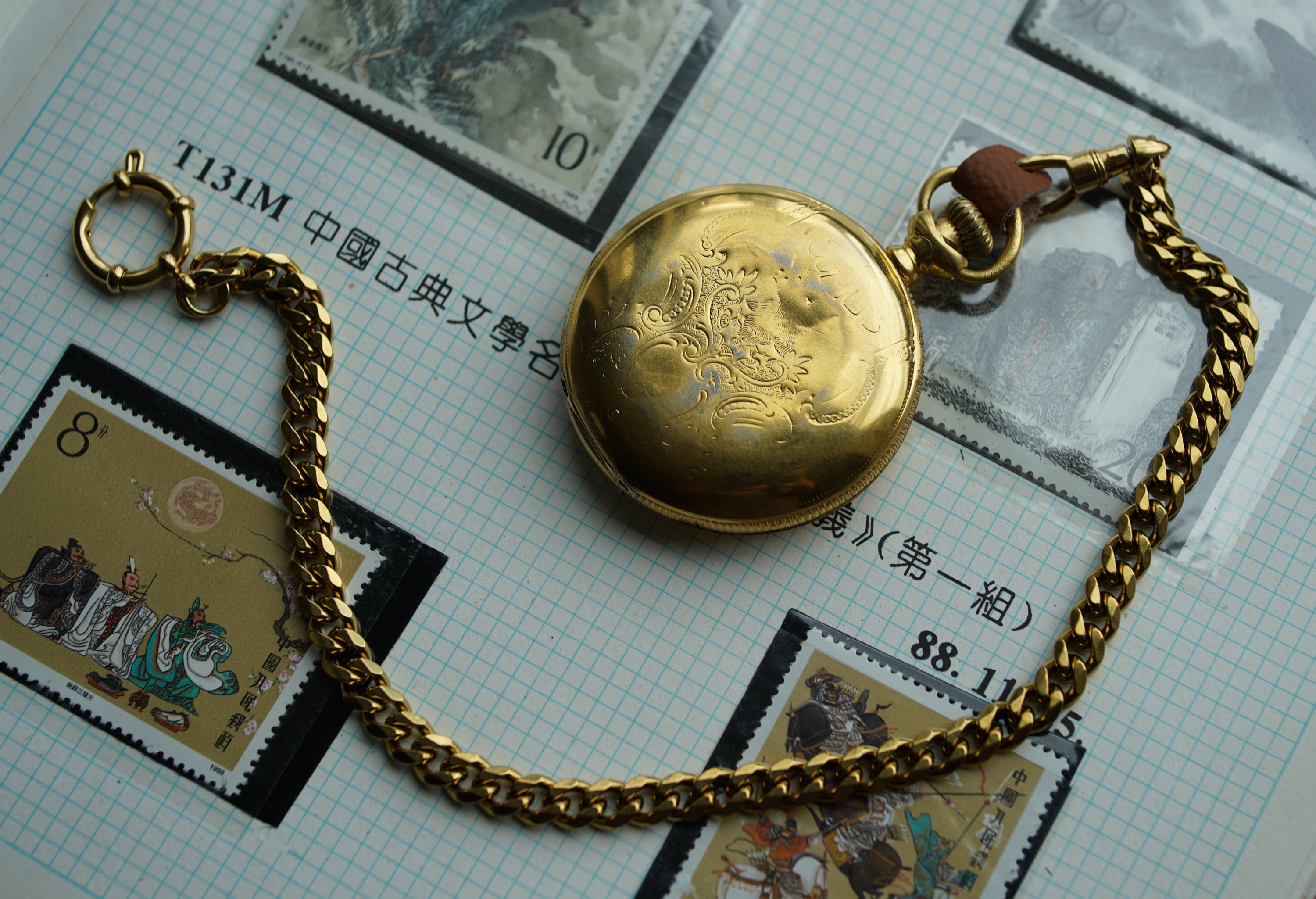
I find myself returning, not for the first time, to the object that inaugurated what I now recognize as a lifelong entanglement with timepieces the one my father gave me—purchased at auction—in 2008, when I was fourteen years old.
Across the street from our home, an auction company had temporarily established itself for a sale of antiques, and among the lots were several pocket watches. My father and I crossed over to look. One watch immediately arrested my attention: this Elgin. I was drawn first to its design, with the unguarded certainty of a child who has not yet learned to distinguish aesthetic attraction from desire. If memory serves, the winning bid was approximately 1,600 yuan.
That acquisition marked the origin of my watch collecting, though I could not then have named it as such. I brought the watch to school with the fervor of a new convert, attached it to a red strap, tucked it into my pocket, and carried it as a badge of identity. I had no knowledge of conservation, no sense of the object’s fragility or its claims to historical integrity. The watch was already somewhat battered when we bought it, its case back thinning in patches where the gold plating had surrendered to the base metal beneath. I certainly added my own abrasions.
A certificate accompanying the watch dated its manufacture to 1894–1896, which meant it was already more than a century old when it came into my hands. Yet I did not regard it as a historical artifact. It was not, to me, a specimen of late-nineteenth-century horology requiring archival distance or curatorial restraint. It was simply my pocket watch—an object to be carried, worn, enjoyed, and displayed to friends without embarrassment or undue reverence.
That youthful possessiveness led me to interventions I would now consider indefensible. When the crystal fell out, I attempted a repair with superglue, spreading it around the edge until the crystal was effectively ruined. The damage remains visible. I also scratched my own name into the inner dust cover, an act of inscription that today would be classified, unsparingly, as a destructive aftermarket modification. But at the time I was not thinking about originality, preservation, or resale value. I had dreamed of owning something like this, and once it became mine, I treated it as fully mine. The scratches, the failed repair, the crude inscription—they became part of a shared history between the object and me.
The watch no longer runs. Yet its significance has almost nothing to do with timekeeping. It recalls my father, the auction across the street, and the particular excitement that opened into a lasting interest in watches. It carries the nostalgia of adolescence and the innocence of a period when I could love an object without anxiety about its condition, provenance, or market value.
Perhaps this is also where I first glimpsed something about timelessness. If an object is truly timeless, its date of manufacture matters less than its capacity to remain present. It can be carried, worn, used, and loved long after the world that produced it has vanished. It may seem anachronistic, even estranged from the rhythms of contemporary life, and yet, for reasons I cannot entirely rationalize, a pocket watch has never seemed outdated to me.
This Elgin may no longer tell the time, but it still holds a particular moment in mine.